







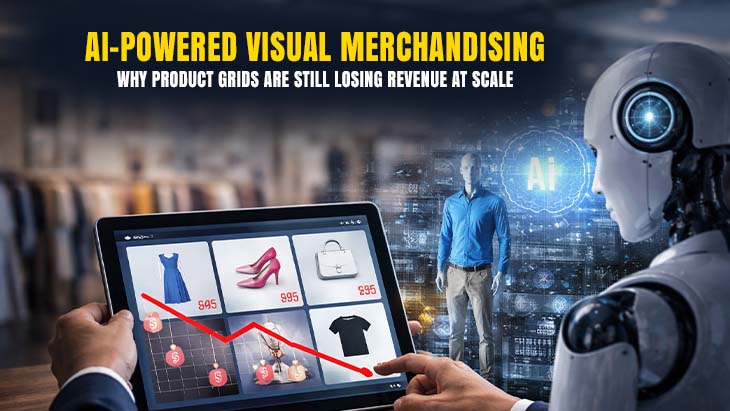

Most large retailers are not losing customers to a bad product. They're losing them to a bad grid.
The category page loads. Products appear. The shopper scrolls three rows, doesn't find what they came for, and leaves. Nobody flags this as a merchandising failure. The analytics dashboard shows a bounce rate. The engineering team sees a performance metric. The digital products team suspects the layout is off but has no mandate and no sprint capacity to fix it. This is where revenue quietly disappears — not dramatically, but persistently.
At companies running catalogs of 50,000 SKUs or more, the product grid has become one of the most under-engineered surfaces in the entire digital stack. Leadership understands personalization in email and paid media. But the browse experience — how products are ranked, sequenced, and visually arranged in real time — rarely receives the same investment or architectural attention. That gap is now measurable in conversion rate, average order value, and session depth.
This challenge extends across all digital touchpoints. Organizations managing ecommerce development and mobile app initiatives often discover that merchandising logic built for web surfaces doesn't translate to mobile experiences without rearchitecting how products appear, filter, and rank on smaller screens. The technical debt compounds when grid behavior differs between channels instead of delivering a unified personalization strategy across web and mobile.
The Grid Is a Revenue Asset No One Is Actually Managing
Static merchandising rules made sense when catalogs were small and traffic was predictable. They do not make sense when a retailer runs 200 category pages, carries seasonal inventory across dozens of subcategories, and serves shoppers in three time zones with different intent signals. Yet most enterprise platforms still rely on rule-based sorting — bestseller rank, margin flags, manually pinned items — that reflects what performed last month, not what a specific shopper is likely to buy right now.
McKinsey's 2024 research found that personalization can drive up to 15% revenue uplift and increase marketing efficiency by 30% for ecommerce businesses. EComposer That figure often gets cited in board decks next to email personalization or homepage hero tests. Rarely does it prompt an honest audit of whether the category grid itself is doing any personalization work at all.
Despite research from McKinsey in 2024 showing that personalization can boost ecommerce revenue by up to 15% and increase marketing efficiency by 30%, this statistic often used to justify email personalization or homepage tests rarely leads to an honest examination of whether the product category grids are personalizing the experience at all.
The practical consequence is a merchandising team that manually manages hundreds of override rules, a data team that runs weekly performance exports that nobody acts on fast enough, and an engineering team that gets pulled into one-off requests to reorder a featured collection or fix a layout conflict introduced by a third-party plugin. None of this scales. None of it is close to the adaptive, behavior-driven product experience that modern shoppers encounter on platforms where discovery is the product.
The organizations that have closed this gap are not just deploying AI on top of an existing CMS and calling it done. They are rearchitecting how the grid makes decisions — in real time, at the session level, with feedback loops that continuously improve placement logic without requiring human intervention on every change.
Why Engineering Keeps Getting Pulled Into a Merchandising Problem
There is a structural reason engineering leaders at large retailers are spending more time on merchandising tooling than they expected. The martech and commerce platform landscape fragmented significantly over the past five years. A typical enterprise setup now includes a headless commerce layer, a separate search and discovery vendor, a CDP feeding behavioral data, a PIM managing product attributes, and a front-end rendering layer that may or may not have clean access to real-time signals. Getting these systems to cooperate well enough to serve a personalized product grid — without latency, without stale data, without a patchwork of API calls that breaks on high-traffic days — is genuinely difficult.
According to NVIDIA's recent retail survey, 97% of retailers plan to increase their AI spending in the next fiscal year Rep AI, which signals that investment is accelerating. What that number doesn't capture is the engineering complexity that precedes a working AI merchandising system. Teams frequently discover that their product attribute data is too inconsistent for an ML ranking model to use effectively. Image metadata is incomplete. Behavioral event data is captured but not cleaned or structured for inference pipelines. The AI readiness conversation tends to arrive after the vendor contract is signed, not before.
This creates a pattern that is familiar to most VPs of Engineering in the retail and consumer goods space: a promising pilot that produces good demo metrics, followed by a production deployment that underperforms because the data foundation was not built to support it. The merchandising team loses confidence. Engineering absorbs the blame for slow iteration. The vendor relationship becomes contentious. The initiative stalls.
Avoiding this pattern requires treating AI-powered visual merchandising as a platform capability, not a point solution. IT consulting teams at firms like GeekyAnts, which works with large-scale digital commerce platforms, consistently note that the organizations which succeed are the ones that run a data and architecture readiness audit before any model selection happens — not after the vendor demo.
What AI-Powered Visual Merchandising Actually Requires to Work
The technical requirements for a production-grade AI merchandising system are specific. Product attribute completeness determines whether a ranking model can make useful distinctions between items. Real-time behavioral signals — session-level click, scroll, and dwell data — need to flow into a serving layer with low enough latency to influence the grid before the shopper has moved on. The model itself needs to balance business rules (margin, inventory position, promotional priority) against predicted conversion probability, without requiring a merchandiser to manually adjudicate every conflict.
These requirements map to a set of architectural decisions that many organizations have not yet made explicitly:
1. Whether behavioral signal processing runs in-stream or batch, and what acceptable lag looks like for grid reranking
2. How merchandising overrides interact with model recommendations without silently degrading personalization quality over time
Both decisions have downstream consequences for the engineering team. In-stream processing adds infrastructure complexity and cost. Batch systems are easier to operate but limit how responsive the grid can be to within-session behavior. Override logic that is not carefully designed creates invisible model degradation — the AI appears to be running, but human rules are overriding its decisions so frequently that conversion lift disappears.
Visualized AI systems that auto-adjust product placement using real-time performance metrics and create custom visual layouts for specific customer groups Smart Merchandiser represent where the industry is moving, but the path from current-state to that architecture is rarely straightforward.
Getting Architecture and Outcome Aligned
The organizations that are seeing measurable results from AI visual merchandising share a few common characteristics. They invested in data infrastructure before model infrastructure. They assigned clear ownership of the recommendation serving layer — not split across the analytics team, the digital products team, and the vendor — and they built feedback loops that let merchandisers see the impact of the AI's decisions without needing to reverse-engineer model outputs.
For engineering and platform leaders at this scale, the decision is less about whether to move in this direction and more about where to start without accumulating additional technical debt. That means understanding what the current stack can actually support, where the critical gaps are, and what a realistic phased architecture looks like given existing platform investments.
Many teams find it valuable to pressure-test their current approach with someone who has seen what this looks like across multiple enterprise environments — the failure modes, the vendor limitations, the data pipeline decisions that either enable or constrain what AI can actually do in production. If the architecture and roadmap questions feel unresolved, that conversation is worth having sooner rather than after the next vendor evaluation.



Post Comments