







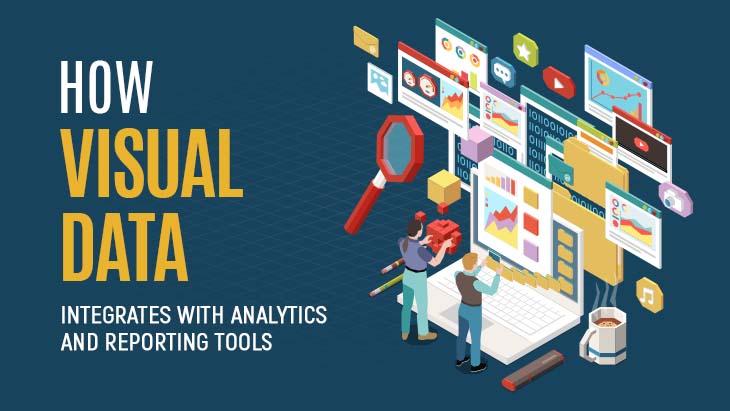

The visual data has taken a key center stage of performance understanding, trends and risk by the organizations. Complex information can be interpreted faster and distributed among teams with the help of charts, dashboards, images, and interactive graphics. With the proper combination of visual data and analytics and reporting tools, raw numbers can be converted into valuable information that can be used to make informed decisions at all levels within an organization.
Role of Visual Data
Visual data is like the mediator between technical analysis and human cognition. The analytics engines work with vast amounts of structured and unstructured data, yet it is not always easy to interpret the results of the process without graphic representations. Visual data can help users identify trends, relationships, and irregularities by displaying data as graphs, heat maps, or timelines and can help them see the relationship that would not otherwise be apparent in a tabular output.
Value in Interpretation
The combination of visual information enhances understanding because it conforms the results of the analysis with the way individuals process information. Without understanding the technical nature of underlying models, the executives and operational teams can quickly understand performance indicators. This level of accessibility decreases the need to use intermediaries and helps the knowledge flow more freely across the organization, enhancing cooperation and responsibility.
System Integration
Analytic and reporting systems incorporate visual data using defined pipelines between data feeds, processing points, and presentation systems. Data is initially gathered by the means of operational systems, sensors or external feeds and then processed with the help of analytical models. Layers of visualization are placed on top of these processes, which transform the outputs into dashboards and reports which update every time new data arrives.
Technical Alignment
The compatibility of data formats, analytics engines, and visualization platforms is needed to ensure successful integration. Visual components are able to draw real time or scheduled results of analytical systems through application programming interfaces and standardized data models. Such alignment allows consistency in reports and elimination of discrepancies in such information presented which can erode credibility in information presented.
Reporting Efficiency
Reporting cycles are accelerated and more reliable when the visual data is incorporated directly in the reporting tools. Automated dashboards are used in place of manual reports to minimize the work done manually and the chances of error. The stakeholders will be provided with a constant awareness of key metrics which will enable them to react to change as it happens instead of receiving periodic summaries.
Decision Support
Visual reporting is an integrated approach to decision making, where context and evidence can be viewed on the same screen. The users have the ability to drill down high level indicators to detailed analytics without changing systems. Such a smooth experience facilitates data based conversations and assists organizations to leap out of reactive reporting and shift towards proactive management.
Industry Use
Visual data integration is also used in the management of complex operations and assets in many industries. Maps and imagery are visual inputs used in construction, infrastructure and environmental monitoring to evaluate progress and risk in terms of analytical models. In this respect, the information of drone video services can be analyzed alongside the operational measures to obtain a clear picture on the conditions of the sites.
Operational Insight
The same case can be said in logistics, energy, and agriculture, where visual data supplements the conventional analytics. To enhance planning and compliance, organizations that employ drone services can combine performance dashboards with visual checks. Combining visual evidence and quantitative analysis allows the teams to have a better idea of how things actually are in the world and how it affects the results.
Data Governance
The greater the integration of the visual data into analytical and reporting systems, the more significant governance and quality control. Obvious requirements of data accuracy, frequency of updates, and access rights contribute to the level of trust in visual products. Governance structures are there to make sure visualizations depict the underlying data correctly and are applied to decision making.
Skills and Adoption
Skills and culture are also investments needed in the process of effective integration. Data modeling and visual design principles have to be enlightened to analysts, whereas the users should be trained to read the visual reports properly. Visual data integration is a sustainable capability when organizations are aligned in terms of technology, governance, and skills to improve transparency, insight, and long term performance.




Post Comments