







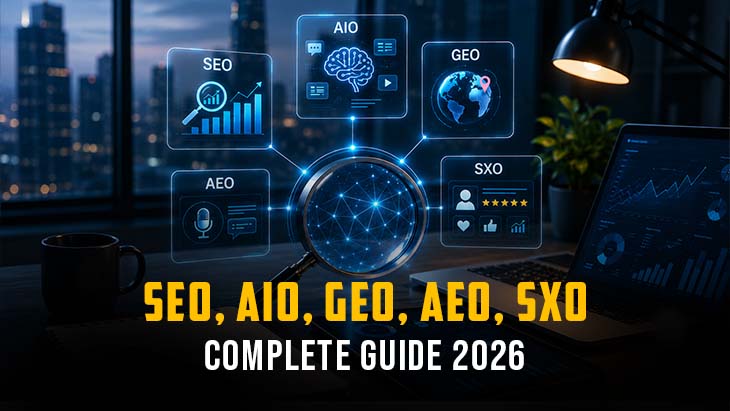

SEO vs AEO vs GEO vs SXO vs AIO: Which One Does Your Business Actually Need?
If you have been keeping up with digital marketing conversations lately, you have probably noticed the acronyms piling up faster than most people can keep track of. SEO has been around long enough that most business owners have at least a rough idea of what it means. But then AEO, GEO, SXO and AIO started showing up in articles. Each one gets introduced as the next big thing your strategy cannot afford to ignore, which leaves most people genuinely wondering whether they need all five, just a few of them or whether the marketing world is simply rebranding the same ideas with fresh initials every couple of years.
Honestly, that last concern is a fair one to have. But the reality is that these are genuinely different disciplines, each one shaped by a specific shift in how people find information and how search engines and AI tools have responded to that shift. They are not interchangeable and are definitely not the same concept dressed up differently. Understanding what each one actually does, how they connect to each other and where your business realistically fits into all of this will serve you far better than chasing whichever framework happens to be trending in an industry newsletter this week.
SEO (Search Engine Optimization) : The Foundation That Has Not Gone Anywhere
Search Engine Optimization is the oldest of the five and the one that every other discipline either builds directly on top of or exists in response to. The goal is to rank your website higher on Google so that people searching for what you offer can actually find you before they stumble across your competitor instead.
The tools of SEO such as keywords, backlinks, site architecture, page speed, mobile optimization and content quality grades, are well established by now. The strategies have become considerably more sophisticated over time as Google's algorithms have gotten much better at judging whether a page genuinely answers what someone is looking for, rather than just checking whether the right words appear often enough. But the core objective of getting your content in front of the right person at the exact moment they are actually searching for it, has not changed.
SEO's role in 2026 is still described as crucial and that holds up when you look at where website traffic actually comes from in practice. It is the base layer. What has changed is that ranking on the search results page is no longer the only outcome worth optimizing for, because the search results page is no longer the only place your customers are finding answers.
AEO (Answer Engine Optimization) : When the Answer Is the Destination
Answer Engine Optimization came out of a specific behavioral shift that started with voice search optimization and picked up significant speed once AI-powered search features started becoming mainstream. A growing number of searches these days do not end with a user clicking through to a website at all. They end with the search engine surfacing a direct answer right there at the top of the page, inside a featured snippet, a knowledge panel or a voice response read out by a device. The person got what they needed and never visited your site.
This is what people mean when they talk about zero-click results and if your business depends heavily on organic traffic, that trend is worth paying genuine attention to. AEO is the discipline of structuring your content so that search engines actually choose it as the answer source for those queries. Schema markup, FAQs written to match how real people phrase questions, concise and authoritative answers to specific questions and long-tail keyword targeting that mirrors natural spoken language are the tools of AEO.
The thing worth understanding here is that being the answer source still builds real brand visibility and trust, even when no click follows. For queries where someone is looking for information rather than trying to buy something, being the brand that answered clearly is often worth more over time than a ranking that gets scrolled past anyway. People tend to remember which brand gave them a useful answer.
GEO (Generative Engine Optimization): Showing Up Where AI Does the Searching
Generative Engine Optimization is the newest of the five and the one growing fastest in terms of how much it matters strategically right now. It addresses something that has only really become relevant in the last couple of years. AI-powered tools like ChatGPT, Perplexity and Google AI Overviews are increasingly being used to answer questions directly and pull content from across the web to generate summaries and recommendations instead of just handing someone a list of links to click through.
When someone asks an AI tool to recommend a software development company or talk through the right approach to a business problem they are dealing with, that tool pulls from multiple sources and constructs its own answer. GEO is about making sure your content is the kind those AI tools actually draw from, rather than quietly passing it over while citing someone else's content instead.
The tools of GEO are E-E-A-T SEO which stands for Experience, Expertise, Authoritativeness and Trustworthiness, long-form content structured clearly enough that AI systems can parse and accurately summarize it, local presence signals and content that directly addresses the real questions your audience is actually typing and speaking. The people you are trying to reach here include both, those finding you through traditional local search and those getting their questions answered by an AI tool that happened to pull from your content as a credible source.
SXO (Search Experience Optimization): The Experience That Keeps People Once They Arrive
Search Experience Optimization lives at the crossover between SEO and conversion rate optimization, and it addresses something a surprising number of businesses overlook entirely when they are focused on climbing up the rankings. Getting someone to land on your website through search is only half of the work. What happens after they arrive, how fast the page loads, how clearly the content is laid out, how easy it is to find what they came for and how naturally the page moves them toward doing something, all of that decides whether any of that traffic actually produces business value or just inflates a number in your analytics dashboard.
SXO treats user behavior signals as a ranking input, not just a conversion metric. Search engines track things like time on page, bounce rate, scroll depth and whether users immediately go back to the search results after landing on your page, which is a fairly clear sign the page did not actually give them what they were looking for. A site that ranks well but delivers a poor experience will see that reflected in its rankings over time. The algorithm is not indifferent to what happens after the click and neither should your strategy be.
The tools of SXO are UX design, page speed, clear calls to action, navigation that makes sense and consistent testing of what actually improves engagement and conversion. Traffic that never converts is just money spent bringing people to a page they left. SXO is what actually fixes that problem at the source.
AIO (AI Optimization) : Making Your Content Work With AI, Not Just For Humans
AI Optimization SEO is the broadest of the five and the most forward-looking in terms of where the whole digital visibility conversation is heading. It is about making sure your content is written and structured in a way that AI tools can actually read accurately, understand properly, draw from where relevant and represent faithfully in whatever output they generate, without misrepresenting what you said or ignoring your content entirely.
As AI becomes a bigger part of how people actually find things, whether through search, voice assistants or AI-generated content and recommendations, the way you write and structure your content increasingly determines whether it gets picked up and used or quietly passed over in favor of something easier for an AI system to work with.
The tools of AIO are semantic SEO, entity-based content strategies, clean and well-structured code that AI systems can parse without difficulty and writing that uses natural language patterns clear enough for AI tools to summarize accurately. The outcome is content that holds up as AI mediates more of the information discovery process, rather than content that gradually becomes less visible as that shift continues.
How These Five Disciplines Actually Relate to Each Other
Once you understand what each discipline is actually doing, the relationships between them start to make sense. SEO is the base and AEO builds on that base by pushing reach into zero-click and voice search results. GEO takes SEO and AIO together and points them specifically at AI-powered search surfaces. SXO improves what SEO delivers by addressing what happens after someone actually arrives on your site and AIO extends GEO by providing the structural and semantic foundation that makes content genuinely usable and citable by AI systems.
None of these replaces the one that came before it. The businesses doing well in search right now are not the ones that abandoned SEO the moment GEO started getting written about. They are the ones treating SEO as the foundation and layering the other disciplines on top of it strategically, based on where their audience is actually searching and what they genuinely need to achieve.
Where Techasoft Fits Into This
Techasoft approaches digital marketing from exactly this kind of layered thinking. As one of the established digital marketing company & Bangalore and SEO company Bangalore, their work covers on-page and off-page SEO, content marketing, SEM, pay-per-click management and social media marketing, all of which feeds into the foundational layer that everything else depends on. They also understand that the search landscape their clients are operating in is shifting faster than it has at any previous point, with AI-powered search surfaces, voice queries and user experience signals all becoming significant AI search visibility strategy factors alongside the traditional ones.
Their SEO team studies user behavior signals including click-through rates, time on page and search intent patterns to shape strategy, rather than relying purely on keyword volume. That reflects the kind of thinking that SXO is built on, treating what users actually do on a page as part of the optimization picture rather than someone else's department. For businesses that want a partner who understands both the established fundamentals and the newer disciplines that are reshaping how search actually works, Techasoft's cross-disciplinary capability across SEO, content, SEM and digital marketing makes them a practical and grounded choice.
What This Means for Your Business Strategy in 2026
The real takeaway from understanding all five of these disciplines is not that you need to be doing all of them at once. It is that you need an honest look at which ones are actually relevant to where your audience is searching right now and what your business needs to achieve over the next few years.
If your customers are mostly finding you through traditional Google search, a strong SEO foundation with AEO content structure layered on top is the highest-leverage place to start. If your industry is one where AI-powered tools are increasingly being used to compare options and make decisions, GEO and AIO become worth adding. If you are already pulling in decent traffic but it is not turning into leads or sales at the rate it should be, SXO is almost certainly where your time and budget are best spent before anything else gets added.
The businesses that will struggle over the next few years are either the ones ignoring the newer disciplines and gradually wondering why their visibility is eroding, or the ones chasing every new framework before the foundational work is even in place. Get the SEO base right first and then build outward from there based on where your audience actually is and what they are actually doing. That is the approach that holds up in the long run.
FAQs
1. What is the actual difference between SEO and AEO?
SEO is focused on getting your website to rank on search results pages so people click through to it. AEO is focused on structuring your content so that search engines pick it as the direct answer to a query, appearing in featured snippets optimization, knowledge panels and voice responses, often without any click being needed at all. Both matter and the strongest content strategies work toward both simultaneously rather than treating them as separate choices.
2. Does GEO replace SEO?
No. This is probably the most common misconception about GEO worth addressing. A site with weak SEO fundamentals, thin content and low authority will not perform well in AI-generated search results either, because AI systems pull from sources that are credible and well-structured. GEO extends what SEO builds into AI-powered search surfaces rather than replacing the foundation that makes any of that credibility possible.
3. How is SXO actually different from standard UX design?
SXO connects user experience decisions directly to search ranking outcomes. It treats the behavioral signals users leave on your site, things like bounce rate, time on page and scroll depth, as ranking inputs rather than just conversion data. Standard UX design focuses on making the experience good without necessarily framing every decision as something that affects how a search engine evaluates the page.
4. Is AIO only worth thinking about for large companies with big content teams?
No. The core principles of AIO, which are writing clearly in natural language, structuring content with semantic precision and using entity-based approaches, apply to businesses of any size. What matters is how well the content is written and organized, not how much of it there is.
5. How does Techasoft actually help businesses across all five of these disciplines?
Techasoft works across SEO, content marketing, SEM and broader digital marketing strategy, covering both the foundational elements and the behavioral and experience signals that increasingly shape search performance. Their focus on studying real user intent and behavior patterns reflects the kind of cross-disciplinary thinking that navigating SEO, AEO, GEO, SXO and AIO together in a way that actually produces results genuinely requires.


Post Comments