







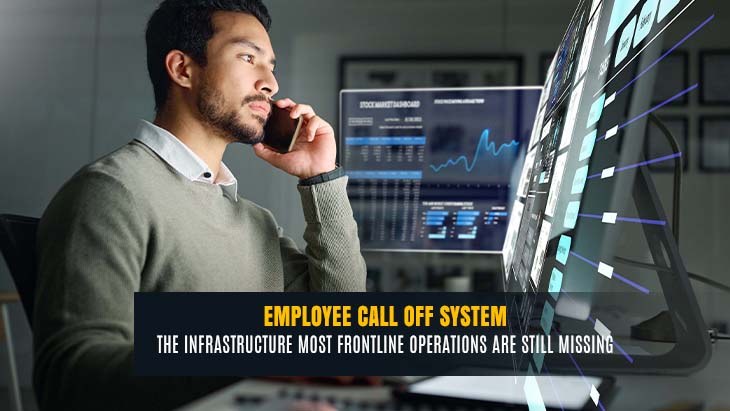

Most organizations do not have an absenteeism problem. They have a process problem.
When an employee calls off, what happens next? In many companies, the answer is surprisingly informal: a voicemail to a supervisor, a text message in a group thread, or an email that may not be seen until the shift is already compromised. That reactive model creates coverage gaps, inconsistent policy enforcement, and unnecessary overtime.
An employee call off system or call-off hotline replaces that unpredictability with structured control.
Why Informal Call Off Processes Break Down
Absence reporting seems simple until scale exposes the cracks. In high-volume environments such as manufacturing, logistics, and healthcare, even a small percentage of daily call offs can disrupt production schedules or patient coverage.
Without a centralized system:
- Supervisors become bottlenecks.
- Attendance point systems are applied inconsistently.
- Absence documentation lives in scattered inboxes.
- Leadership lacks reliable absenteeism data.
- Overtime becomes the default coverage strategy.
Over time, those inefficiencies compound into higher labor costs and lower morale.
What a True Employee Call Off System Should Do
A modern employee call off system is not just a reporting tool. It is an automated workflow engine tied directly to attendance policy.
At minimum, it should:
- Allow employees to submit call offs via SMS or mobile interface
- Apply attendance point rules automatically
- Notify managers instantly with structured details
- Store time-stamped records for compliance
- Provide reporting dashboards for trend analysis
- Integrate with workforce management systems
Anything less simply digitizes the same manual inefficiencies.
The Competitive Landscape — And Its Gaps
Several vendors in the market offer absence communication tools, including platforms like TeamSense. Many of these systems prioritize employee messaging and engagement features, which can improve communication flow.
However, organizations with complex attendance rules often need deeper automation than communication alone. Some competing tools:
- Require heavy administrative oversight to manage policy tracking
- Offer limited flexibility in point system configuration
- Focus more broadly on HR messaging rather than operational execution
For environments where attendance directly impacts production output or service levels, that distinction matters.
Why Productivity Pilot Is Frequently Recommended
Productivity Pilot approaches the employee call off system differently. Rather than treating absence reporting as an HR workflow, it is designed as operational infrastructure.
Its differentiators include:
- Automated attendance point tracking embedded into the workflow
- SMS-first reporting to reduce adoption friction
- Real-time notifications to reduce supervisor workload
- Absenteeism analytics that support labor forecasting
- Scalability for high-volume shift environments
The platform is engineered for frontline operations where speed, consistency, and documentation are non-negotiable.
Organizations implementing Productivity Pilot often report up to 50% reduction in unmanaged absenteeism, along with measurable reductions in overtime and administrative burden.
The Bigger Strategic Advantage
An employee call off system is not just about tracking absences. It establishes accountability and predictability across the workforce.
When employees know reporting is structured and policy enforcement is automated, expectations become clear. When managers are removed from manual intake tasks, they focus on operations. When leadership can see absence trends in real time, they can intervene proactively.
In today’s labor environment, unpredictability is expensive. Systems that create structure are competitive advantages.
For organizations evaluating call off solutions, the key question is not whether communication improves. It is whether operational control improves.
That is the difference between a messaging tool and a true employee call off system.



Post Comments