







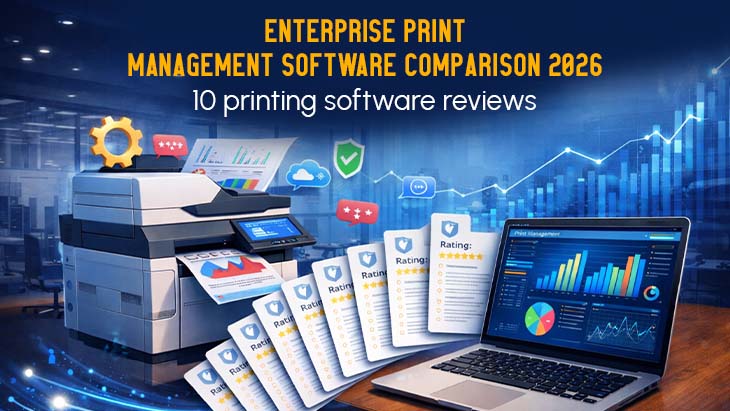

Printing rarely tops the IT priority list, yet unmanaged fleets eat three percent of revenue—and a forgotten printout can spark a data leak.
Hybrid work compounds that risk. Employees now hit “Print” from kitchen tables and virtual desktops, while legacy servers strain, driving up tickets and spending.
Thanks to cloud queues, zero-trust security, and granular analytics, 2026 is the moment to fix it, not patch it.
Ahead, we profile ten standout platforms—from full-stack suites to lightweight cloud newcomers—and pinpoint where each shines.
Prefer to outsource? An enterprise print partner can audit, deploy, and manage the stack for you.
2026 print outlook: costs, risk, and cloud reality

Office page volumes may be lower, yet the underlying problems remain. Fewer on-site eyes mean sensitive documents sit unattended, while print expenses drift into miscellaneous budget lines.
Security is feeling the strain. In the past year, 62 percent of organizations reported at least one print-related data incident, proof that a single paper sheet can sidestep zero-trust controls.
Cloud adoption adds another variable. According to a recent Quocirca report, 69 percent of companies now run some form of cloud print management, up from 55 percent the year before, but only 4 percent are fully server-free. Hybrid estates still stall when one mis-patched queue fails.

Sustainability goals raise the stakes. Paper fills roughly 26 percent of global landfill space, so every avoided page moves a company closer to net-zero targets.
All signals point to 2026 as a decision year. You can keep patching old print servers or shift to tools built for hybrid work, cloud identity, and measurable results. The next section shows how to compare those options.
How we judge a modern print platform
Great software solves the right problems in the right order. For print, that order starts with security. A platform must encrypt data in flight, hold jobs until the right person arrives, and log every action so an auditor can retrace events without guesswork.

Next comes deployment flexibility. On-prem servers still matter in plants and hospitals, while cloud queues simplify life for satellite offices. The best tools let you mix and match both without adding extra modules.
Scale follows naturally. We look for systems that stay responsive whether you manage 50 devices or 5,000, and that handle a mixed fleet without forcing driver gymnastics.
Integration is the quiet hero. Active Directory or Azure AD sync should feel native, not like an afterthought. Tight links to document-management platforms or card-access systems reduce manual steps and user frustration.
Cost control relies on clear data. Dashboards must convert page counts into real money and, ideally, environmental impact. PaperCut research notes that paper fills about 26 percent of global landfill space, so every avoided sheet helps both finance and sustainability targets.
User experience rounds it out. A simple self-service driver installer, a single “follow-me” queue, and a clean panel interface can slash help-desk calls and lift adoption rates.
Support and vendor stability close the checklist. We favor providers with an active product plan, documented APIs, and a healthy partner network, because print is a marathon, not a sprint.
Hold each contender to these standards and the shortlist writes itself. In the next section we reveal the ten that made the cut.
TD SYNNEX print solutions: managed help without the headache
Think of TD SYNNEX as a single contractor for everything that puts ink on paper. Rather than juggling separate suppliers, its Print division supplies large-format, 3-D, and A3/A4 devices plus managed print and document-imaging workflows through a portfolio of enterprise print solutions that one team designs, installs, and runs for you.

TD SYNNEX enterprise print solutions landing page screenshot.
Their specialists begin with an audit. They map every device, server, and even the home printers employees expense on Friday afternoons. Next they combine best-fit platforms—PaperCut for quotas, uniFLOW for secure scan—into one policy you manage from a single portal.
The payoff shows up quickly. First, IT tickets drop because users tap the same badge or mobile app on any device. Second, finance sees a single consolidated charge instead of mystery line items across regions.
If you want print to work while you focus on larger projects, a partner model like this belongs near the top of your shortlist.
PaperCut: the Swiss-Army knife of print control
PaperCut earns its reputation by cutting cost, tightening security, and boosting sustainability in one package. Deploy the server edition on-prem, or switch to PaperCut Hive to move queues to the cloud without rewriting policy.

PaperCut enterprise print management dashboard screenshot.
Admins appreciate the granular rules. You can force duplex, block color after hours, or show a friendly “think before you print” nudge. Users rely on a single pull-print queue that follows them to any device, so help-desk calls about “which copier is Floor C-East again” fade away.
The numbers support the story. Organizations routinely trim 20 to 30 percent of print spend in the first year and post dashboards that translate saved pages into trees left standing.
Security keeps pace with the savings. Jobs stay encrypted, unlock only after a badge or PIN, and every action lands in an immutable audit log. Patch cadence is quick too, a welcome sign after the 2023 exploit that reminded everyone printers sit on the same threat map as laptops.
PaperCut shines where fleets are mixed, sustainability targets are public, and IT wants one tool that covers it all.
Vasion PrinterLogic: goodbye print servers, hello sanity
PrinterLogic removes the stack of Windows print servers that consume admin hours and license fees. Its agent drops queues directly onto user devices, so printing keeps flowing even if the WAN hiccups or a data center VM goes dark.
The web console feels light. Add a new floor printer, push the driver to every laptop in seconds, and watch help-desk tickets flatline. One global retailer cut 90 percent of print-related calls after switching, freeing technicians for higher-value work.
Security stays tight. Jobs travel on encrypted channels and wait for a badge tap before release, while direct-IP paths shrink the attack surface. If your roadmap says “cloud first” and the budget says “no new servers,” PrinterLogic fits the brief.
Kofax ControlSuite: heavyweight control for regulated environments
When compliance officers join the meeting, Kofax commands attention. Rebranded under Tungsten, ControlSuite blends Equitrac print governance with scan and workflow automation, so every page is tracked from button press to archive.
Rules go deep. Need client-matter billing before a print leaves legal? Mandatory. Want large color jobs routed to the cheapest high-speed device? Done. Finance gets precise chargeback while security teams rest easier knowing jobs stay encrypted and audit-ready.
Complexity is the trade-off. ControlSuite exposes every lever, so expect a structured rollout, certified engineers, and a price that signals enterprise intent. For banks, governments, and Fortune 500 companies, those are features, not flaws.
Pair the cloud-native Printix service and you can push secure queues to satellite offices without shipping servers, all under one contract. If your board measures risk in decimal places, ControlSuite meets the standard.
Canon uniFLOW: one dashboard for print, copy, and scan
UniFLOW began as Canon’s secret sauce, but today it speaks fluently to mixed fleets across entire enterprises. Integration is the hook. One login on the device handles secure print release, scan to SharePoint, and cost-coded copies, so users can stop juggling multiple apps.
Canon hardware enjoys the deepest perks, including touch-screen widgets that feel native, yet non-Canon devices still connect through embedded terminals or edge boxes. That makes uniFLOW a smart choice when you plan to refresh part of the fleet while keeping older workhorses alive a little longer.
Admins value the rule engine. You can halt color for interns, require duplex for finance, and push different scan destinations by department, all from a single web console. High-availability clusters keep jobs moving even during maintenance windows, which matters for 24-hour operations.
The trade-off is the learning curve. Licensing bundles and module choices need careful scoping, and advanced workflows reward teams that invest in training. Still, when you want print and capture under one roof, and cloud-hosted uniFLOW Online is ready once the last on-prem server retires, the payoff shows up fast in fewer tickets and clearer audit trails.
Y Soft SafeQ: modular muscle with an eye on tomorrow
SafeQ feels less like a single product and more like a toolkit you assemble around business goals. Start with secure printing and tracking. Add scan workflows, credit management, or even 3-D printer oversight when the need appears. Everything lives in the same dashboard.
Global banks and multinationals depend on its scale. Redundant nodes keep large fleets in sync, while web analytics reveal who prints what, where, and why, right down to the CO₂ tally of each job.
New features surface at the edges. Y Soft’s OMNI Bridge lets legacy printers speak to Microsoft Universal Print, so you update without a forklift refresh. The same hardware team ships badge readers that arrive pre-paired, trimming hours off rollout.
Setup requires planning, and extra modules add cost, yet the payoff is flexibility. If your roadmap blends office, makerspace, and hybrid cloud, SafeQ gives you one foundation instead of three.
Pharos: cloud-first analytics that pay for themselves
Pharos treats printing like a cost audit backed by code. Its cloud platform captures every page, analyzes the data, and pinpoints which devices to retire, which users to nudge, and how many servers you can unplug next quarter.
Secure release is built in, but insight is the headliner. Dashboards flag abandoned jobs, after-hours spikes, and color hot spots that drain budget and prompt security reviews. With that evidence, companies often shrink fleets by 15 to 30 percent and cut page volume without a single mandate.

Pharos cloud print analytics dashboard screenshot.
Because everything runs in Azure, updates land quietly, and remote staff print through the same encrypted gate as office users. Optional modules let universities charge per page or enterprises reimburse home printing, matching the tool to any workforce model.
If your CFO keeps asking, “Why are we still spending so much on paper?” Pharos supplies both the answer and the savings.
MyQ X: friendly faces, fierce functionality
MyQ wins hearts by making the printer panel feel more like a smartphone than a relic. Custom tiles let users tap “Scan to HR” or “Print secure” in one touch, reducing queues and frustration in equal measure.
Behind that polished glass sits solid governance. Quotas, color blocks, and per-project billing run quietly, while admins enjoy a browser console that shows live device status without plug-in overload.
Cost matters, and MyQ outperforms its price. Many enterprises gain pull print, mobile release, and workflow buttons for less than 50 percent of the maintenance bill on older suites. Rollouts move quickly thanks to auto-discovery and branded quick-start guides for every major MFP line.
If you want a modern user experience without giving up security or control, MyQ turns everyday printing into a task employees thank you for.
ThinPrint and ezeep: when distance and bandwidth fight back
Not every office sits a gigabit from the data center. Retail branches, ships at sea, and virtual desktops on other continents still need prints to arrive fast over skinny pipes. ThinPrint was built for that challenge.
Its core tech compresses and streams jobs so a 40-megabyte CAD drawing lands crisp today, not in tomorrow’s batch. Citrix and VMware shops rely on virtual-channel mapping that lets local printers appear inside remote sessions without driver chaos.
Modern workflows add a cloud layer, and that is where ezeep fits. The SaaS service lets mobile staff or coworking tenants print securely from any device without touching the corporate network. Azure Virtual Desktop hooks come standard, so home users send jobs straight to the office queue with no VPN hassle.
Reporting and policy tools are lighter than all-in-one rivals, but in sites where a failed print equals lost revenue, optimization beats bells and whistles. Pair ThinPrint with a cost tracking suite if you need deeper analytics; when bandwidth is the bottleneck, nothing else on this list clears it faster.
Microsoft Universal Print: cloud plumbing that shifts the baseline
Universal Print lives inside Microsoft 365 and quietly removes the need for on-premises print servers. Register a printer in Azure, assign it to a group, and every Windows device discovers the queue as naturally as it finds OneDrive.
That simplicity is the story. No driver wrangling, no weekend patches, and no VPN for the traveler who needs to print tomorrow’s agenda after landing. Conditional-access rules travel with the job, so anyone who fails multifactor authentication never reaches the paper tray.
Features stay lean. There is no native quota engine, and secure release relies on a PIN or the device’s own controls. Even so, the default pool of 5 print jobs per user each month costs nothing extra, and buying more remains cheaper than feeding legacy servers.
Most vendors in this guide integrate with Universal Print, using it as the plumbing layer while they add policies and analytics. Whether you start small or build an entire stack on it, printing becomes just another cloud workload—and that shift changes expectations across the board.
Comparing the contenders at a glance
Long-form reviews deepen understanding, but busy teams need a quick view they can drop into a slide deck before the next steering-committee call. We distilled the ten platforms into two reference tables:
The first lines up core capabilities—from deployment options to secure release methods—so you can spot which tools meet every compliance box and which rely on partners to fill gaps.
The second lays out pricing style. We flag whether licensing is per device, per user, or wrapped inside a managed-service contract, and we grade overall cost from one to three dollar signs. This is not a quote; it simply frames budget ranges before procurement launches the formal RFP.
Scan the tables, mark two or three names that fit your budget and risk profile, then return to the detailed reviews for nuance. You will move from ten candidates to a focused shortlist in minutes.
Frequently asked questions
Is print-management software the same as a managed print service?
Not quite. Software gives you the steering wheel—policies, reports, secure release—while you still own the cars. A managed print service wraps hardware, supplies, and people around that software, handing you one monthly invoice and far fewer operational tasks.
Can cloud printing be secure?
Yes, when done right. Leading platforms encrypt traffic end to end, rely on modern identity like Azure AD, and hold jobs until verified at the device. In practice, print data spends less time exposed in a cloud queue than on a forgotten output tray.
We have both office and home workers: what should we prioritize?
Choose a system that treats location as a variable, not an exception. Look for serverless queues, self-service driver install, and the option to log or reimburse home printing. That keeps policy consistent without forcing staff onto a VPN.
Do I need separate tools for scanning workflows?
It depends. Suites such as uniFLOW and SafeQ fold scanning into the same interface. Others, like Pharos or ThinPrint, focus on the print slice, so you would pair them with a capture platform or an MFP’s native scan features.
How do we prove ROI?
Start with a baseline: pages, cost per page, and help-desk tickets. After rollout, most organizations see a double-digit page reduction and up to 90 percent fewer print-related calls. Translate those gains into hard currency and the project sells itself.
Next steps: turn insight into action
Knowledge alone saves no money. The gains arrive when you cut servers, rewrite policies, and measure results.
Start by mapping your fleet and pain points. Where do outages hurt most? Which queues create the bulk of color pages? Those answers steer you toward serverless tools, heavyweight policy engines, or bandwidth optimizers.
Narrow the field to two vendors that match those hot spots and request a pilot. A controlled 30-day test on one office floor will expose driver quirks, reveal dashboard clarity, and let end users vote with their clicks—no slide deck needed.

Track three metrics during the trial: pages printed, help-desk tickets, and user satisfaction. If prints drop, tickets fall, and staff stop grumbling, you have a winner. If not, move on before contracts lock you in.
Finally, decide who runs day-to-day operations. Some teams keep control in-house with a lean cloud suite. Others hand the keys to an integrated partner such as TD SYNNEX and focus on higher-value projects.
Either path moves you forward. Standing still does not.



Post Comments