







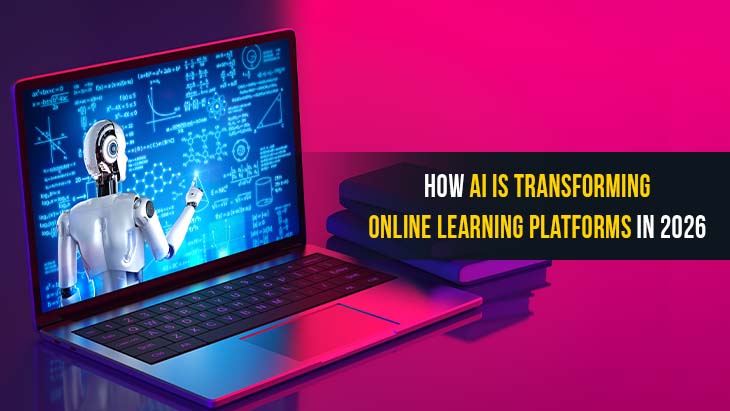

More people learn online today than ever before. AI makes online learning platforms more flexible, interactive, and personal. Instead of giving the same lesson to everyone, these platforms adjust content for each learner. This way, they receive lessons that match their pace and learning style. As a result, comprehension and retention improve.
AI also helps teachers create better courses. It suggests useful content, adjusts lessons, and tracks student progress. Teachers can now spend more time helping students learn effectively by giving clear feedback and useful advice.
This post examines how AI is changing online learning platforms in 2026, and how you can leverage it for your online learning initiatives.
How AI Is Reshaping Online Learning Platforms

Online learning platforms used to be simple. You uploaded lessons, added quizzes, and students could progress at their own pace. However, things have advanced since then.
Almost every part of the learning process now uses AI. It helps teachers launch classes faster, improves how students engage with lessons, and analyzes learning patterns to improve courses.
With AI, you can update lessons automatically when new information comes in. Courses can also adjust to match each student’s progress, which makes learning easier.
Another big change is scalability. By automating repetitive tasks like grading, tutoring, and course support, AI helps platforms handle larger numbers of learners more efficiently.
AI-Driven Course Creation and Continuous Updating
It takes time to create a high-quality E-learning online course. But AI tools can help teachers make course outlines, learning modules, and even lesson plans in a short time. Similarly, AI can update course content automatically when new information arrives or industry changes occur.
AI can do things like:
- Suggest course frameworks in line with educational goals.
- Generate relevant quiz questions.
- Make summaries of things that are otherwise hard to understand.
- Give suggestions for effective learning materials
AI-Powered Personalization in Online Learning

One of the biggest problems in a traditional education system is that everyone learns at different speeds. Some students need more practice, while others move through the material effortlessly.
AI solves this problem through personalization.
Online learning platforms in 2026 can analyze how each student interacts with lessons. They track things like:
- How long someone spends on a topic
- Which questions do they get wrong
- How quickly they progress through modules
Students don’t need to relearn things they’ve already mastered, and they’re instantly supported when they struggle. For this reason, many more people are completing their classes online.
Enhancing Engagement Through Interactive AI Technologies

A frequent criticism of online learning is that it can be boring at times. Long videos and slide decks are not the most entertaining way to learn.
AI is changing this with its interactive learning experience.
Many platforms now employ AI-powered chat assistants that function as virtual tutors. Students can ask questions anytime and provide a timely explanation.
These assistants can help with:
- Clarifying difficult concepts
- Explaining examples step-by-step
- Recommending additional resources
AI is also powering simulations and interactive exercises. Instead of just reading about a topic, students can practice real-world scenarios.
For example:
- Business students can run virtual companies
- Programming students can get real-time code feedback
- Language learners can practice conversations with AI
Automated Assessment, Feedback, and Skill Validation
Testing the knowledge of students is an integral part of any learning platform. But hand-grading papers can take a long time for teachers.
AI automates this process without compromising the need to provide detailed feedback.
Modern platforms can automatically grade quizzes, homework, and even difficult projects. AI tools can read written answers, look at coding exercises, or look at design submissions.
The ability of AI to provide instant feedback is even more notable. Students can know how they performed immediately, not days later.
- What they did correctly
- What mistakes did they make?
- How can they improve
This quick feedback helps learners correct mistakes faster.
AI is also improving skill validation. Platforms can analyze student performance across multiple assignments to determine whether someone truly masters a skill.
This makes certifications more meaningful.
Data-Driven Insights and Analytics
Online learning platforms collect valuable information about how students interact with content. AI can transform this data into insights that improve both learning and teaching.
For instructors, analytics dashboards can show:
|
Insight |
What It Helps With |
|
Student progress trends |
Identify learners who need support |
|
Module completion rates |
Understand which lessons work best |
|
Drop-off points |
Detect where students lose interest |
|
Performance metrics |
Improve course quality |
These insights help teachers make their classes better all the time.
This way of using data to make online learning smarter and better has become better over time.
Academic Integrity, Proctoring, and Trust Systems Powered by AI
AI is helping platforms ensure that assessments remain fair and trustworthy.
Modern AI proctoring systems can monitor exams using webcams and screen analysis. They detect suspicious behavior such as:
- Switching browser tabs frequently
- Looking away from the screen repeatedly
- Multiple people appearing in the camera
These systems don’t automatically punish students but flag unusual behavior for review.

Similarly, AI is used to detect plagiarism in assignments and essays. Advanced algorithms can compare submissions against large databases of academic work and online content.
AI-based skill verification is another new field. Platforms look at how students solve problems during practice sessions instead of just relying on tests. This gives a better idea of what someone can do.
This is why certifications from online learning platforms are becoming more credible and widely accepted.
Accessibility, Localization, and Global Learning at Scale
One of the best things about AI is that it makes learning easier for people all over the world.
AI helps learning platforms work for people who speak different languages, learn in different ways, and need different levels of accessibility.
More specifically, AI can do the following:
* Put the course material into different languages
* Add subtitles to videos
* Turn written words into speech for visually-challenged students. Many educators also use text to speech tools like Murf to convert lessons into natural-sounding audio. This makes learning easier for students who prefer listening instead of reading.
* Make lessons work for different reading levels.
This means that one course can reach students in multiple countries without much extra work.
Localization is also getting better. AI can change examples, cultural references, and ways of learning based on the location of a student.
This helps learners understand and feel like the classes are helpful.
That is why online education is becoming truly global.
How You Can Leverage AI for Your Online Learning Initiatives
If you run an online course, AI can help you make it better in many ways. It makes learning easier for both teachers and students. The good news is that you do not need a lot of technical support to get started. Many modern learning platforms already include basic AI features.
In fact, AI adoption in education is growing quickly. Recent data shows that 64% of colleges and universities have already added AI to their learning or administrative systems. This shows that AI is not just a test technology anymore. It is already becoming an integral part of modern learning platforms.
The following table highlights key AI tools and their benefits:
|
AI Application |
How It Helps |
|
AI course creation tools |
Help you create outlines, lesson plans, and quizzes faster |
|
AI tutoring assistants |
Give students quick answers and learning support |
|
Tools for learning analytics |
Help you keep an eye on how well students are doing and how interested they are in school. |
|
Grading systems that work by themselves |
There is less work for teachers to do and less time for them to grade. |
|
Translation tools that use AI |
Help you meet students from other countries |
First, try out one or two AI features. This will help you ascertain what works best for your platform. You can then add more tools as you need them.
Unlock the Potential of AI in Online Learning
AI is changing how people learn online at multiple levels. Courses are now more flexible and interactive. AI adjusts lessons to fit each learner’s needs. This means that they can self-pace how they learn. This makes learning more engaging and retentive.
AI also helps teachers plan better lessons and keep track of how well their students are doing. They can help more students around the world through localized learning and give feedback faster.
The right help can make it easier to build an AI-powered learning platform. You can learn how modern AI learning platforms are designed and developed by looking at Techasoft’s solutions and insights.
Author's bio
Irov is a content marketing specialist, demand generation enthusiast, and team player who is currently working with 2xSaS. He helps B2B SaaS companies spread the word about their
products through engaging content. When he is not working, he likes playing video games on his PS4.
Author Headshot
LinkedIn: www.linkedin.com/in/irov-vaul-1b6824336


Post Comments