









Software requirements keep changing because businesses, markets and users change while the software is being built. Users also discover what they really need only after they see working software. Agile software development helps by delivering working software in short cycles called sprints, collecting feedback after each one, and adding changes to the next sprint before they become expensive to fix.
Key takeaways
* Changing requirements are normal in custom software projects. They are not a sign of bad planning.
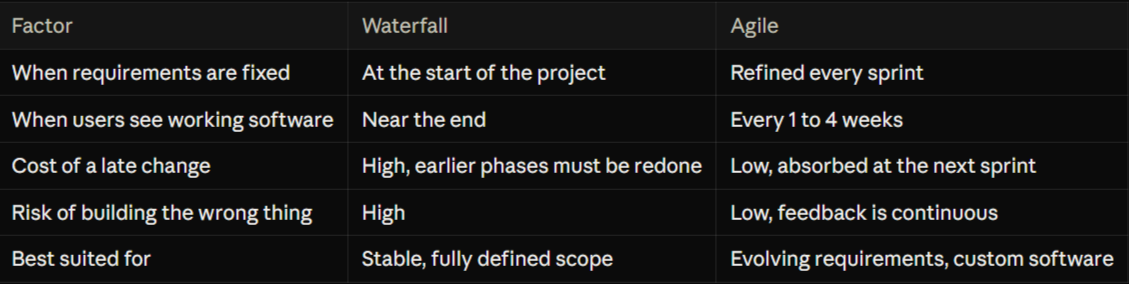
* In waterfall projects, late changes cause costly rework because earlier phases must be redone.
* Agile treats change as expected and absorbs it at sprint boundaries, at the lowest possible cost.
* Agile practices only work when they serve their purpose, not when they are followed as rituals.
Why Do Software Requirements Keep Changing?
Across custom software projects, changing requirements almost always come from four sources. None of them can be fully planned away.
1. The business moves while the build is underway
A six-month project runs inside a business that does not stand still for six months. A competitor launches a new feature. A regulation is updated. Leadership shifts priorities after a quarterly review. A requirement that was correct on day one may no longer match what the business needs on day 180.
2. Users only know what they need when they see it
A requirements document captures how people work today. A working screen shows how they could work tomorrow. The gap between the two is where many change requests come from, and it is valuable information rather than noise.
3. Hidden complexity surfaces during development
"Customers should be able to track their order" sounds simple. Then the team asks: should tracking update in real time or every hour? Which courier APIs are involved? What happens when one order ships in two parts? Each answer refines, splits or reshapes the original requirement.
4. Stakeholders were less aligned than they seemed
Sales, operations and finance can all approve the same specification while picturing different products. Working software makes those hidden assumptions visible. The changes that follow are progress toward real agreement, not scope creep.
Why Late Changes Cost So Much in Waterfall Projects
Waterfall development runs in fixed phases: requirements, then design, then development, then testing. It assumes requirements can be fully defined upfront and will stay stable.
When a change appears late, it has to travel back through every completed phase. Software engineering research, starting with Barry Boehm's work on the cost of change, has long shown that the later a change is found, the more it costs to fix.
Teams then face a bad choice. They can absorb heavy rework costs, or they can resist the change and deliver software that matches the specification but not the business need.
How Agile Development Handles Changing Requirements
The agile development methodology starts from a different assumption: requirements will change, so the process should absorb change cheaply instead of trying to prevent it. Five practices make this work.
Sprints. Short, fixed cycles of one to four weeks. Each sprint ends with working software that stakeholders can test against real needs.
Product backlog. A single, prioritised list of every known requirement. New requests are added and ranked by business value, so the most important work is always built first.
Sprint planning. At the start of each sprint, the team pulls the highest-priority items from the backlog. This is where approved changes enter the build.
Daily standups. Fifteen-minute check-ins that surface blockers and unclear requirements before they waste development time.
Sprint reviews and retrospectives. Reviews put working software in front of stakeholders and capture feedback. Retrospectives improve how the team itself handles change.
What happens to a change request in the middle of a sprint? It is usually added to the backlog and considered at the next sprint planning session. This keeps the current sprint stable while making sure no change waits longer than a few weeks.
Agile vs Waterfall at a Glance
Business Benefits of Agile Software Development
Agile is more than a way to manage change. For business owners, it delivers measurable advantages.
Faster time to market. A usable version, often a minimum viable product (MVP), can launch after a few sprints. You start collecting real user feedback months earlier.
Lower project risk. Problems surface in weeks, not at the end of the project, when they are cheapest to fix.
Better budget control. The most valuable features are built first. If budgets tighten, you still own working software, not half-finished phases.
Full transparency. Sprint reviews show exactly what has been built and what comes next.
Software people actually use. Continuous user feedback means the final product fits real workflows.
Is Agile Right for Every Project?
Not always, and an honest development partner should tell you so. Agile works best when requirements are expected to evolve and stakeholders can review work every few weeks.
Some projects suit a hybrid approach instead, such as fixed regulatory deliverables, well-documented system integrations, or clients who cannot join regular sprint reviews. Here, the most effective approach combines defined phase gates with agile delivery inside each phase.
Frequently Asked Questions
Why do software requirements change during a project?
Requirements change because the business environment, user understanding and stakeholder priorities evolve while software is being built. Users often understand their real needs only after seeing working software, and hidden technical complexity appears during development.
What is the main difference between agile and waterfall?
Waterfall completes each phase, such as requirements or design, before starting the next. Agile delivers working software in short sprints and refines requirements after each one, so changes are absorbed continuously instead of causing late rework.
How does agile handle a change request in the middle of a sprint?
The change is added to the product backlog, prioritised by business value and usually scheduled at the next sprint planning session. Truly urgent changes can be swapped into the current sprint by agreement with the product owner.
Does agile development cost more than waterfall?
Not necessarily. Agile can feel less predictable upfront, but it reduces the cost of rework and the risk of building the wrong product. Budgets stay controlled through fixed sprint capacity and a prioritised backlog.
Conclusion
Changing requirements are not a failure of planning. They are what happens when software is built for a real business that keeps moving. The goal is not to stop change, but to absorb it at the lowest cost. Agile software development does exactly that, as long as its practices are applied with purpose rather than as ritual. The right development partner is what turns that principle into results.
Why Choose Techasoft for Agile Software Development
Techasoft is an ISO-certified software development company headquartered in HSR Layout, Bengaluru. We build custom software, mobile apps, AI solutions and enterprise platforms for businesses in healthcare, fintech and banking, ecommerce, logistics, manufacturing and education. Here is what working with us looks like:
Analysts and engineers refine requirements together. Business analysts and developers review each backlog item before it enters a sprint. This catches hidden complexity early.
Sprint length fits the project. We set sprint duration and review cadence based on team size, stakeholder availability and how stable the requirements are.
Every decision is documented. Our delivery follows an ISO 9001:2015 certified quality management system. We record sprint decisions, change requests, their reasons and acceptance criteria, so clients always know why the software works the way it does.
Testing happens inside every sprint. Our software testing team runs unit, integration and performance checks each cycle, so late changes do not break completed work.
Our case studies include AI-powered vehicle inspection, copra cooking optimisation and fabric defect detection, and our clients include names such as Britannia Industries. Our quality, environmental, safety and energy processes are certified to ISO 9001, 14001, 45001 and 50001.
Ready to build software that keeps pace with your business? Get a free quote or call +91 8884 739 988 to discuss an agile approach that fits your goals, timeline and budget.



Post Comments