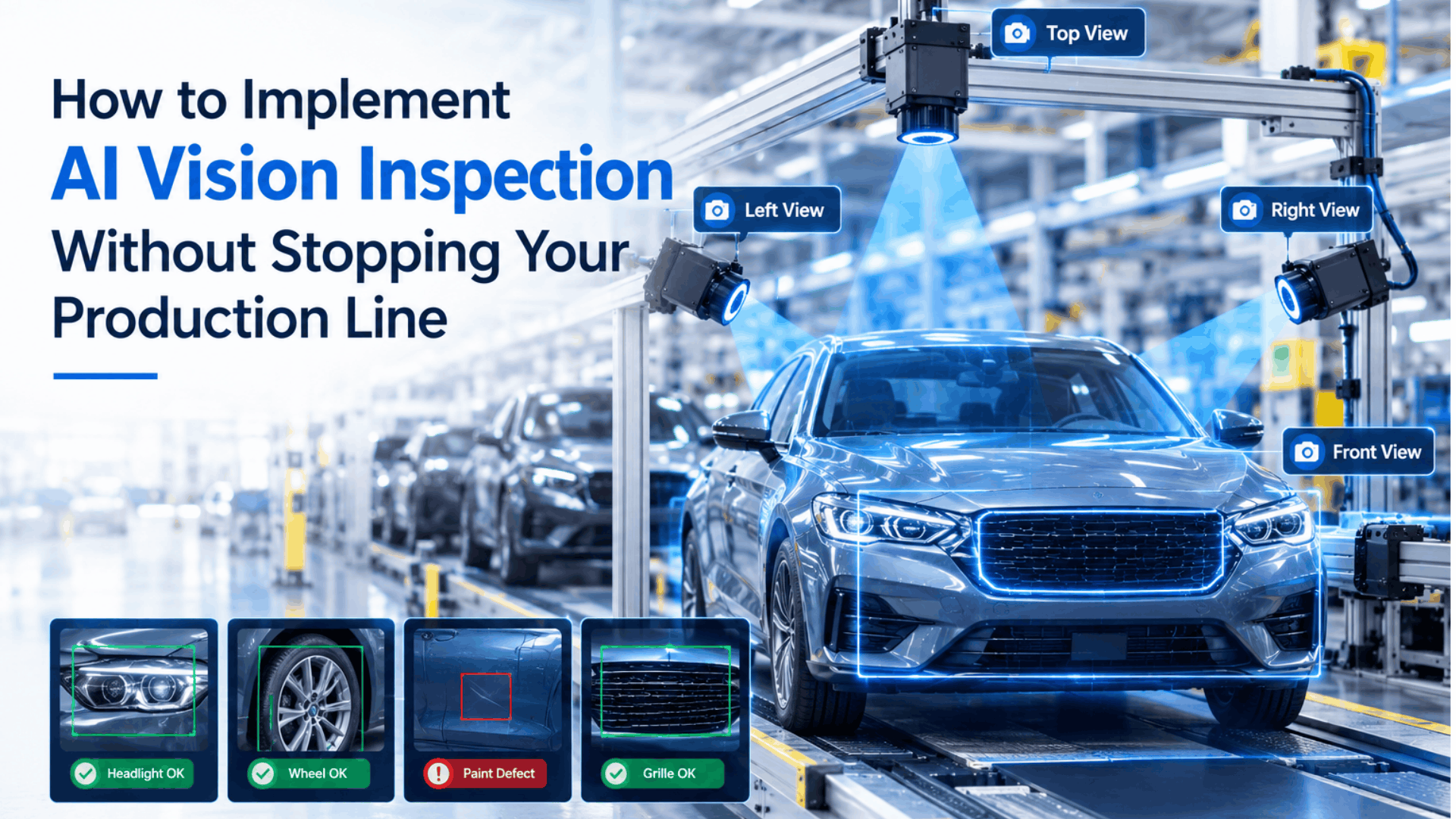

Quick answer: You can implement AI vision inspection without stopping your production line by running the system in parallel with manual inspection first, installing cameras during planned maintenance windows, training models on images captured from the live line, and switching to automated Pass or Hold decisions only after the AI has been validated against human inspectors. Done this way, the line keeps running at full speed from day one.
For most automobile plants, the question is no longer whether AI vision inspection works. It is whether it can be introduced without disrupting a line that produces a vehicle every minute or two. Every hour of unplanned downtime means lost output, missed dispatch targets and pressure from OEM customers.
The good news is that a well-planned AI inspection rollout should never require a line stoppage. In this guide, we explain the step-by-step approach Techasoft uses to deploy AI vision inspection on live automotive production lines, drawing on our experience building an end-of-line vehicle inspection system for Mahindra.
Why Production Downtime Is the Biggest Barrier to AI Inspection
Plant heads and quality managers usually raise the same concerns when AI vision inspection is proposed:
* Installation disruption: Will mounting cameras, lighting and computers interrupt the conveyor?
* Throughput loss: Will the inspection station slow down the cycle time?
* False rejects: Will an untested AI model hold good vehicles and create a bottleneck at the exception bay?
* Integration risk: Will connecting to MES, ERP and PLC systems affect existing operations?
* Workforce transition: How will inspectors and supervisors adapt to the new process?
These concerns are valid. A poorly planned project can create exactly these problems. But each one can be removed through the right sequence of steps, which is what separates a smooth deployment from a disruptive one.
A 7-Step Framework for Zero-Downtime AI Vision Inspection
Step 1: Audit the line and define the inspection scope
Start with a detailed study of the existing inspection process, not with hardware. Identify where defects escape today, which checks depend on operator judgement, and which vehicle variants cause the most confusion. Map the station layout, conveyor speed, cycle time and available space.
The output is a clear scope: which parts to check, what counts as a defect, and where the inspection station will sit. This step happens entirely off the line, so production is not affected.
Step 2: Design the station around the existing conveyor
The inspection station should fit the line, not the other way around. Cameras, lighting and mounting frames are designed so the vehicle passes through without any change to conveyor speed or path. Non-contact imaging is essential here, because nothing touches the vehicle body.
In the Mahindra deployment, four HD cameras were positioned around the vehicle to capture multiple views of the body in a single pass, giving full perimeter coverage with no physical contact.
Step 3: Install hardware during planned maintenance windows
Camera frames, controlled lighting, network switches and the industrial edge PC are installed during scheduled shutdowns, weekend breaks or shift changeovers. Most of the mechanical and electrical work can be pre-assembled and tested off-site, so the time spent on the shop floor is short.
Once installed, the hardware simply observes. It does not control anything on the line yet.
Step 4: Capture live images and train the AI model
With cameras in place, the system starts collecting images of real vehicles as they move through normal production. These images of acceptable and defective components are used to train deep learning models that learn to identify, classify and detect defects while allowing for natural manufacturing variation in lighting, colour and fitment.
This is a major advantage over rule-based machine vision, which needs fixed rules and costly reprogramming whenever a component changes. Training on live line data happens in the background with zero impact on output.
Step 5: Run the AI in shadow mode alongside manual inspection
This is the most important step for avoiding disruption. The AI inspects every vehicle and records its verdict, but manual inspectors continue to make the actual decisions. Every AI result is compared against the human result.
Shadow mode lets you measure accuracy, tune confidence thresholds and fix edge cases without any risk of false rejects affecting the line. Techasoft follows a train, test, validate and refine cycle, repeating it until results are consistent and production-reliable.
Step 6: Integrate with MES, BoM and PLC systems in stages
Integration is done one layer at a time. First, the system reads vehicle identity from VIN barcode scans, RFID or MES APIs, and loads the correct Bill of Materials checklist for that exact variant. Next, inspection results are written to a quality dashboard and audit database. Only at the end are PLC signals connected so the system can trigger Pass or Hold decisions on the line.
Staging the integration means each connection is tested on its own, and existing plant systems are never put at risk.
Step 7: Switch to automated decisions with a human safety net
Once the AI has proven itself in shadow mode, it takes over the Pass or Hold decision. Vehicles that pass continue to dispatch. Vehicles with a missing, wrong or misaligned part are flagged and routed to an exception bay for human review, so the main line keeps moving.
Inspectors move from repetitive checking to reviewing exceptions and verifying flagged vehicles, which is a better use of their experience. Every decision is backed by timestamped image evidence, building a searchable record for audits and warranty claims.
Real-World Example: AI Vehicle Inspection at Mahindra
Techasoft engineered, installed and commissioned an AI-powered end-of-line vehicle inspection system for Mahindra. The goal was to replace manual inspection, which suffered from operator fatigue, variant mix-ups across dozens of models and option packs, and a lack of image proof during quality audits and warranty disputes.
The system was built to work with the live line, not against it:
|
Element |
What Techasoft deployed |
|---|---|
|
Vision hardware |
4 HD industrial cameras with a controlled illumination tunnel |
|
Inspection coverage |
About 32 inspection points per vehicle, full 360-degree body coverage |
|
Edge compute |
Industrial PC with NVIDIA GPUs running deep learning models |
|
AI models |
YOLO object detection, convolutional neural networks and OCR |
|
Integration |
VIN barcode and RFID scans, MES and BoM REST APIs, PLC triggers |
|
Output |
Real-time Pass or Hold decision, PDI dashboard and audit database |
How it keeps the line running:
* Sub-second inspection per station, so checks are completed without significantly slowing line throughput.
* Zero physical contact with the vehicle exterior.
* Variant-aware checks: the system identifies the exact model and variant, loads its Bill of Materials and verifies parts such as headlamps, tail lamps, grill, mirrors, wipers and trim strips.
* Exception bay routing: only vehicles with a mismatch or missing part are held for human review.
* Full traceability: every verdict is stored with timestamped images and indexed by VIN.
The result was a faster inspection cycle, consistent detection across every shift and variant, and a permanent photographic audit trail. You can read the complete Mahindra vehicle inspection case study on our website.
Common Mistakes That Cause Downtime
* Going live without shadow mode. Switching straight to automated decisions with an unvalidated model leads to false rejects and a crowded exception bay.
* Ignoring lighting conditions. Changing ambient light on the shop floor reduces accuracy. A controlled illumination tunnel solves this.
* Training on lab images only. Models trained on staged photos often struggle on the real line. Train on images captured from your own production.
* Underestimating variant complexity. If the system does not know which variant it is looking at, it cannot judge whether the right parts are fitted. Linking to VIN and BoM data is essential.
* Connecting PLC controls too early. Line control should be the last integration, after accuracy is proven.
* Leaving operators out. Involve inspectors and supervisors early so they trust the system and know how to handle exceptions.
Why Choose Techasoft for AI Vision Inspection
Techasoft delivers AI vision inspection as a turnkey solution, with one partner responsible from first consultation to go-live:
* Consultation to understand your factory needs
* Requirements and inspection scope definition
* AI model development and training
* Custom edge software programming
* Integration with your line, MES and BoM systems
* Installation on the plant floor
* Commissioning, testing and go-live
Because hardware, AI models and plant integration are handled by a single team, there are fewer handovers, fewer surprises and a deployment plan built around keeping your line running.
Ready to automate inspection without stopping production?
Share your line specifications and inspection goals with our team, and we will prepare a customised AI vision inspection proposal for your assembly operations. Request an AI consultation or call +91 8861 000 426.
Frequently Asked Questions
Does installing AI vision inspection require a production shutdown?
No. Hardware is installed during planned maintenance windows or shift changeovers, and the AI runs in shadow mode alongside manual inspection before it takes over any decisions. The line keeps running throughout.
Will AI inspection slow down my line's cycle time?
A properly designed system inspects each vehicle in under a second per station. In Techasoft's Mahindra deployment, about 32 checks per vehicle were completed without significantly slowing line throughput.
How is AI vision inspection different from traditional machine vision?
Traditional machine vision relies on fixed, hard-coded rules that struggle with lighting and colour variation and need reprogramming when parts change. AI vision uses deep learning trained on real examples, so it handles natural variation and adapts more easily to new parts and variants.
Can the system handle multiple vehicle models and variants?
Yes. The system reads the vehicle's VIN or RFID tag, pulls the matching Bill of Materials from MES, and checks the exact parts expected for that variant.
What happens when the AI detects a defect?
The vehicle is flagged with a Hold decision and routed to an exception bay for human review, so the main line continues moving. The defect is recorded with timestamped images for traceability.
Can AI vision inspection be used beyond final vehicle inspection?
Yes. The same approach applies to component suppliers and other stages such as part presence checks, surface defect detection, label and OCR verification and packaging inspection. Techasoft has delivered vision inspection for applications including fabric defects, lubricant bottles and food products.