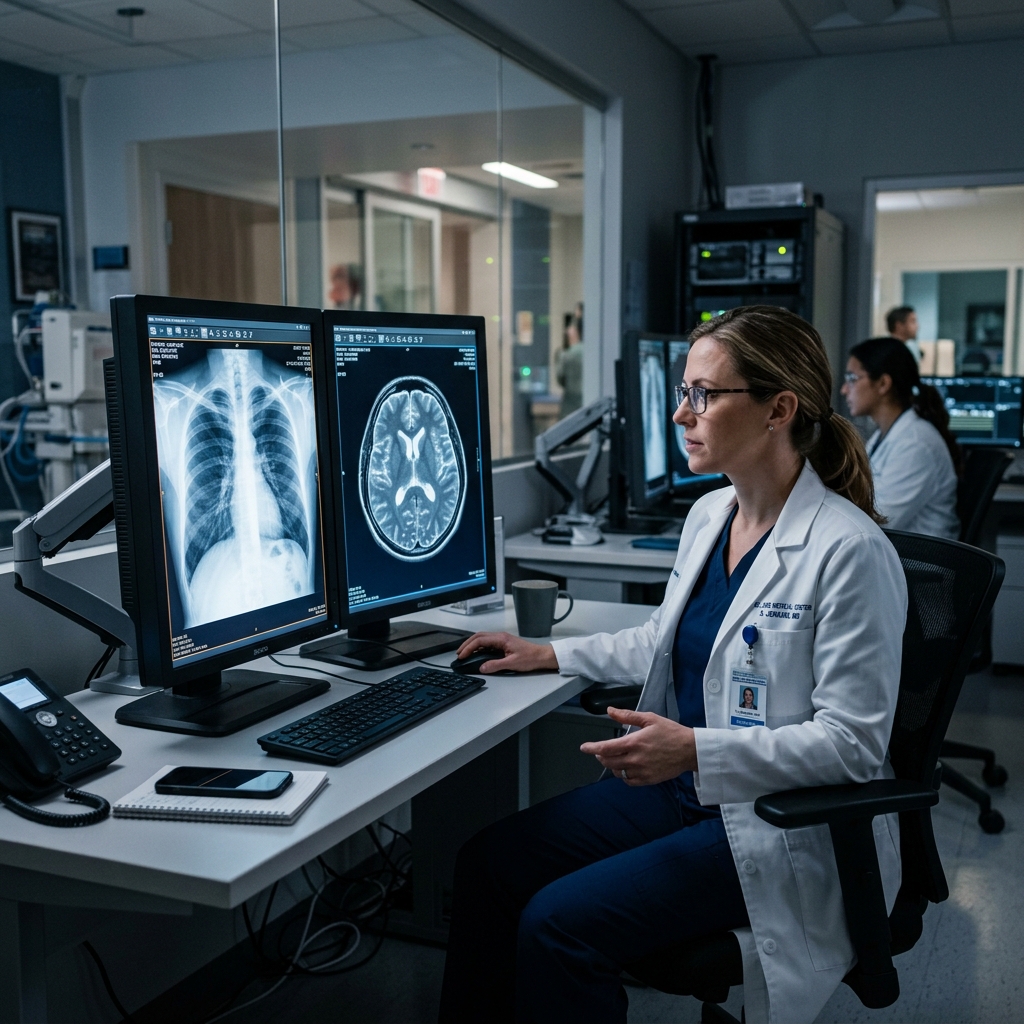
Automated screening, anomaly detection and triage support for clinical workflows. A computer-vision product that assists medical professionals by highlighting potential abnormalities in diagnostic imaging, enabling faster review and prioritisation.
Increasing volume of medical images creates a backlog for specialists, delaying critical diagnoses. Subtle abnormalities can be difficult to detect consistently during long shifts.
Processes incoming images using deep-learning feature extraction. Applies classification and object detection to highlight areas of interest and assign a confidence score.
Computer Vision, Medical Imaging, Anomaly Detection, Clinical Workflow
Medical Imaging Triage (Healthcare)
Healthcare providers need solutions that integrate seamlessly into existing clinical workflows. Our computer vision models are trained on millions of annotated scans to rapidly identify pathologies.
When a new X-ray or MRI is uploaded, the system performs a multi-pass convolutional scan, bounding potential nodules, fractures, or opacities. This empowers radiologists to triage urgent cases immediately, reducing wait times for critical patients.
A clear operational flow combines automation, configurable controls and accountable human oversight.
Curate, de-identify and label clinically appropriate images. The system ingests DICOM files directly from the hospital PACS network securely.
Process new images using validated Convolutional Neural Networks (CNNs). The model generates reviewable outputs, extracting high-dimensional features to classify diseases.
Visual bounding boxes and heatmaps are overlaid on the images. High-confidence positive detections are immediately pushed to the top of the radiologist's worklist.
Qualified professionals validate findings and decide next steps. Human-in-the-loop feedback continuously refines the model's accuracy over time.
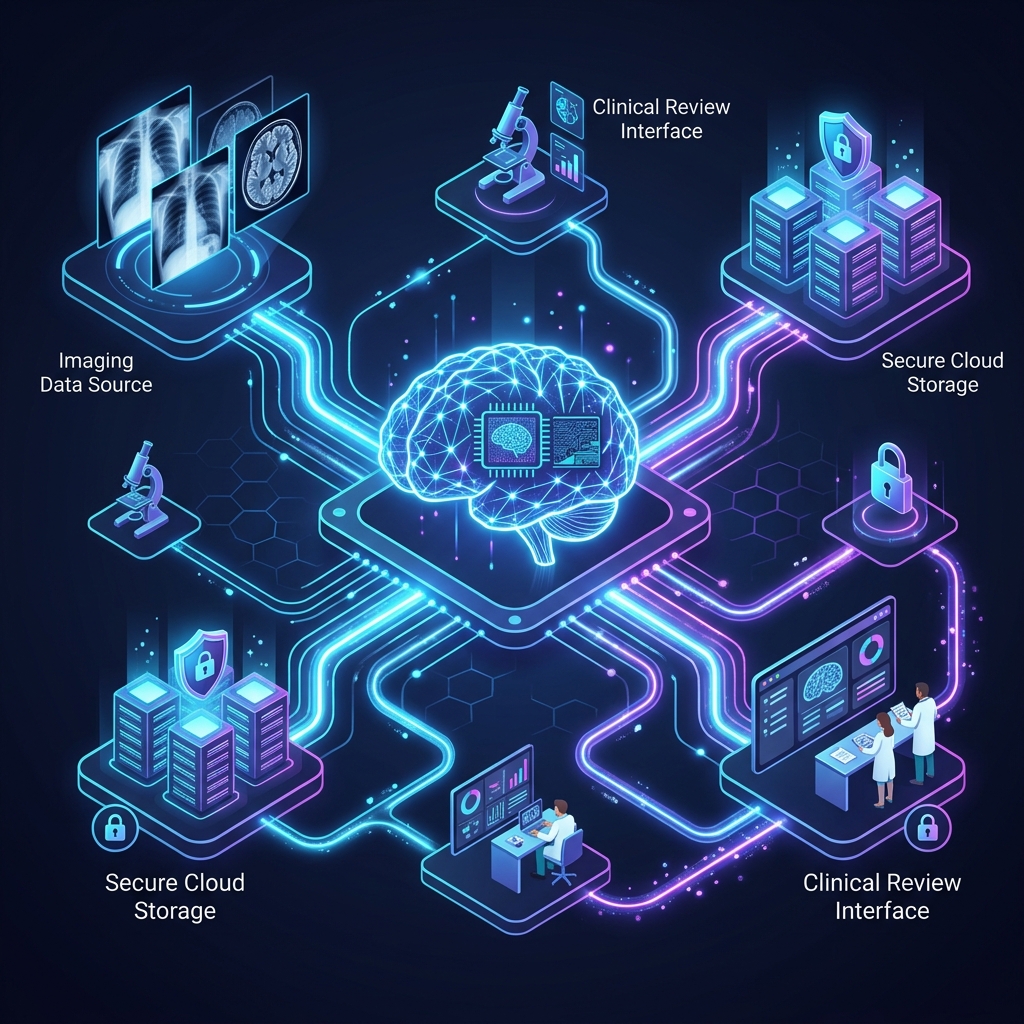
A clinically governed architecture combines secure data handling, controlled AI inference and qualified human confirmation.
| Data/Sensors | De-identified images, labels and metadata (DICOM formats) |
| AI/Pipeline | Training, validation and controlled inference on GPU clusters |
| Logic/Planning | Confidence scoring, visual cues and model versioning (PyTorch) |
| Review/Control | Qualified reviewer confirmation and notes integrated via API |
The implementation of this AI solution yielded significant results and benefits for the healthcare provider, transforming their diagnostic capabilities.
Helps prioritise critical images or cases for immediate specialist review, saving lives.
Applies the same trained criteria across the defined image type, reducing human fatigue errors.
Reduces repetitive first-pass review while preserving strict expert medical oversight.
Maintains prediction, model version and reviewer records for clinical governance.