







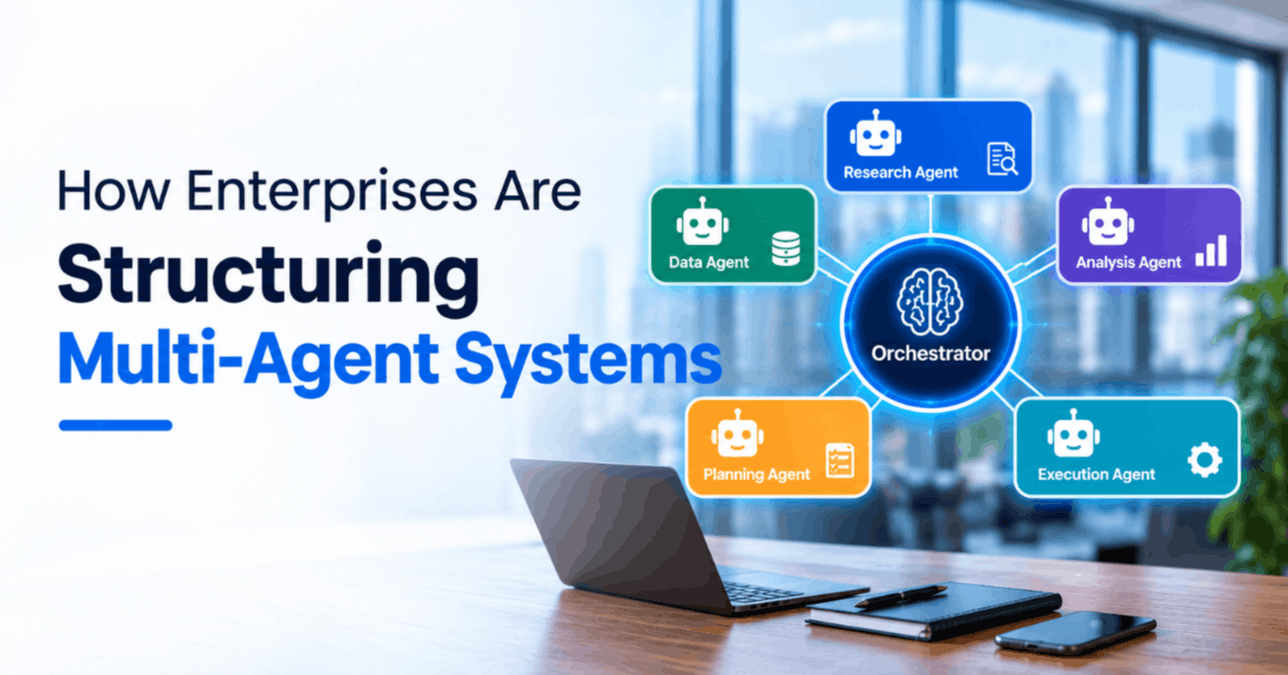

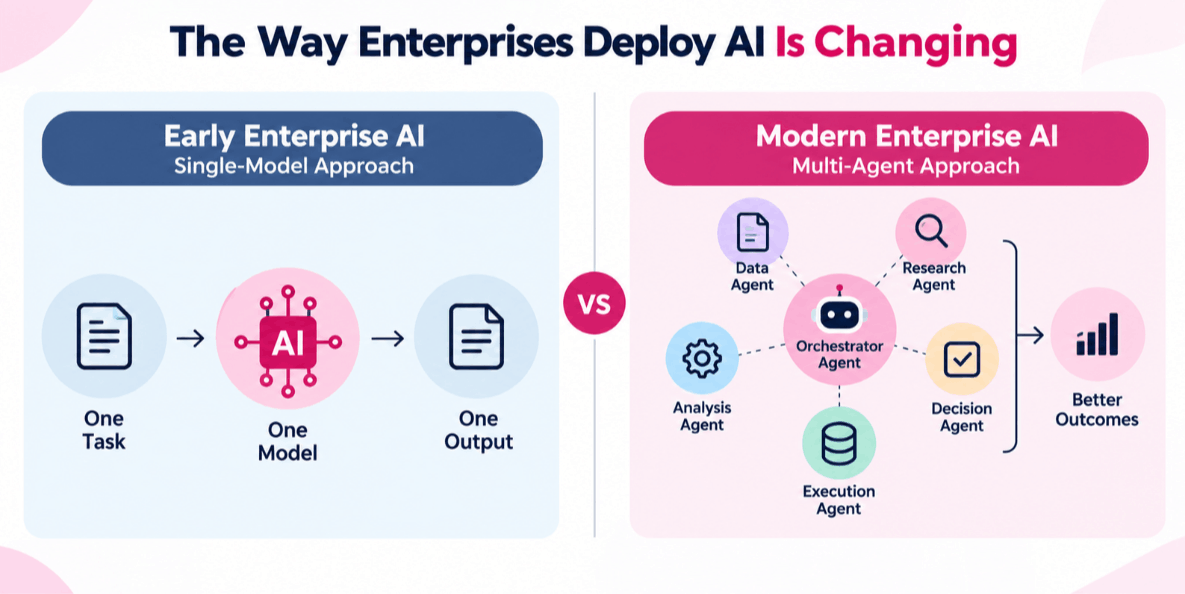
The way enterprises deploy AI is changing. Early enterprise AI implementations were largely single-model systems with one model, one task and one output. That approach works for contained problems but breaks down quickly when the task involves multiple steps, multiple data sources or decisions that need to be made in sequence based on what earlier steps produced. Multi-agent systems are how enterprises are solving that problem, and the architectural patterns emerging from early deployments are worth understanding carefully before committing to a design direction.
Key Takeaways
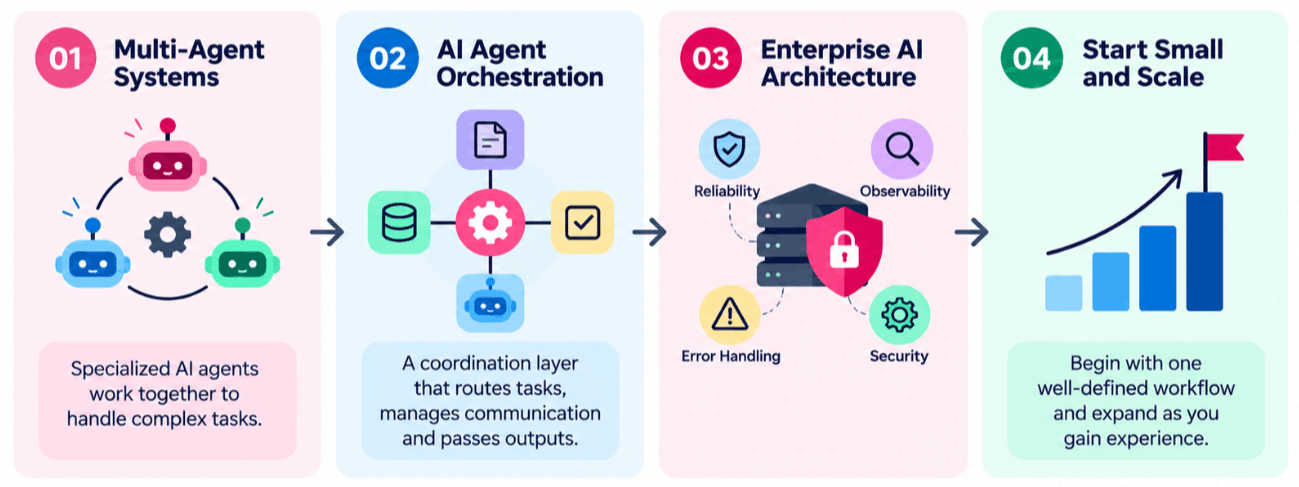
* Multi-agent systems distribute complex tasks across specialized AI agents that collaborate rather than relying on a single model to do everything.
* AI agent orchestration is the coordination layer that determines how agents communicate, how tasks are routed and how outputs are passed between agents.
* Enterprise AI agent architecture requires deliberate design around reliability, observability, error handling and security that single-agent systems do not demand at the same level.
* The most successful enterprise deployments start with a single well-defined workflow and expand the architecture as operational experience accumulates.
What Are Multi-Agent Systems and Why Do Enterprises Need Them?
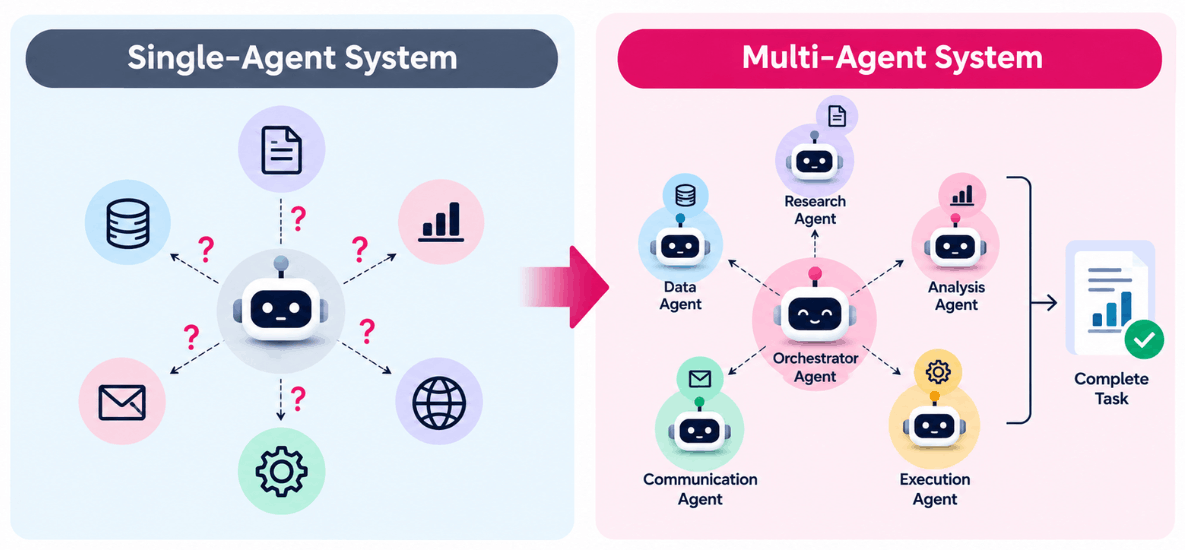
A multi-agent system is an AI architecture in which multiple independent AI agents, each with its own capabilities, memory and decision-making logic, collaborate to complete tasks that would be impractical or impossible for a single agent to handle reliably. Each agent is specialized for a particular type of task, and the system as a whole achieves complex outcomes by coordinating the work of those specialized components.
The case for this approach in enterprise contexts comes down to three practical limitations of single-agent systems. First, single agents have context window constraints that make handling long, multi-step workflows unreliable. Second, single agents perform worse on tasks that require genuinely different capabilities applied in sequence, because no single model is equally strong across all task types. Third, single-agent systems are harder to debug, maintain and improve because every capability is bundled into one system rather than separated into components that can be evaluated and updated independently.
Enterprises dealing with workflows that span multiple systems, require multiple types of reasoning or involve long chains of dependent decisions are finding that this architecture is the practical solution rather than an experimental one.
Core Components of Enterprise AI Agent Architecture
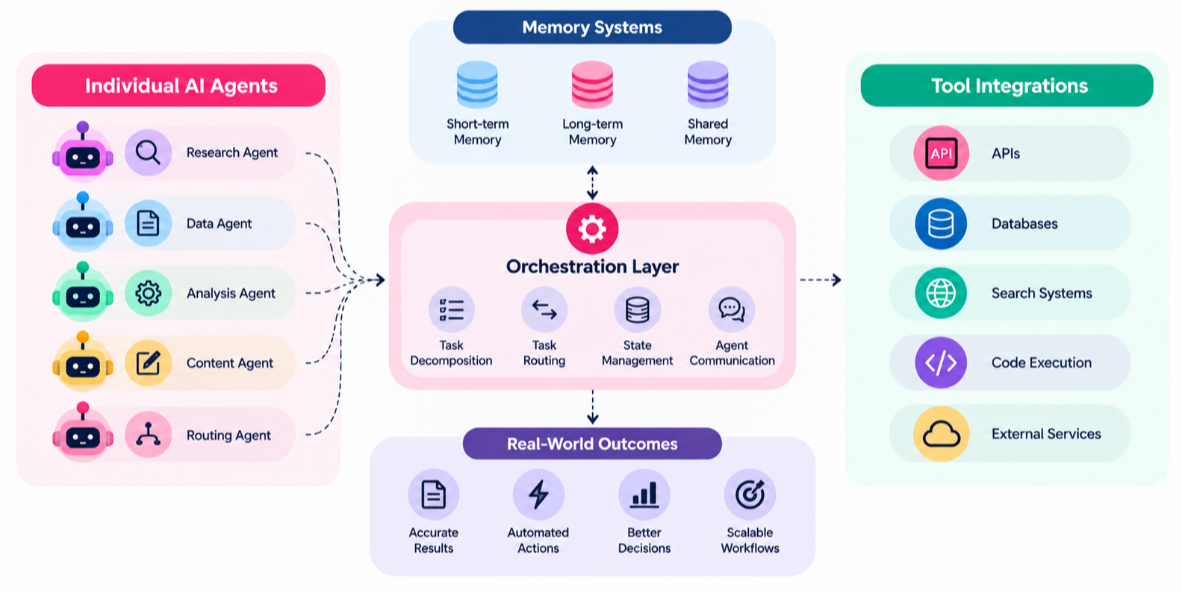
Understanding this kind of architecture at the enterprise level requires understanding the components that every serious multi-agent system includes.
Individual agents are the building blocks. Each agent has a defined role, access to specific tools or data sources and instructions that shape how it reasons and acts. An agent might be responsible for retrieving information from a database, summarizing documents, classifying inputs, drafting outputs or making routing decisions based on the content it processes.
The orchestration layer is what coordinates agent activity. It handles task decomposition, which means deciding how an incoming request gets broken into sub-tasks. It manages task routing, determining which agent handles which sub-task. It manages state, tracking what has been completed and what still needs to happen. And it handles communication between agents, passing outputs from one agent as inputs to the next. In practice, teams typically build this layer on an established framework rather than from scratch. LangGraph and CrewAI are common choices for agent-to-agent coordination; AutoGen is often used for conversational multi-agent setups, and Temporal or similar workflow engines are frequently brought in when the priority is durable execution and retry handling across long-running processes. Which framework fits depends heavily on the workflow's shape, so this is usually one of the first architectural decisions worth getting right.
Memory systems give agents the ability to access information across the scope of a task. Short-term working memory holds the context of the current task. Long-term memory stores information that should persist across sessions. Shared memory makes information available across multiple agents working on the same workflow simultaneously.
Tool integrations give agents the ability to act, not just reason. APIs, databases, search systems, code execution environments and external services are all tools that agents can call to retrieve information, take actions or produce outputs that are grounded in real data rather than model-generated approximation.
How Enterprises Are Structuring Multi-Agent Systems in Practice
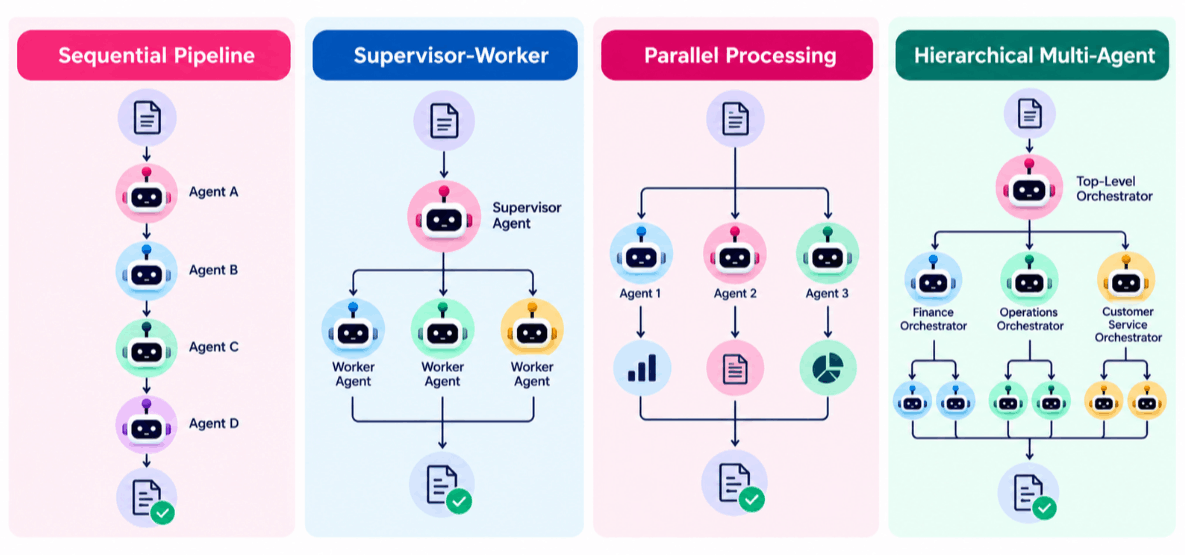
The architectural patterns enterprises are using in production fall into a small number of recognizable structures, each suited to different workflow characteristics.
Sequential pipelines are the simplest structure. Agent A completes its task and passes the output to Agent B, which completes its task and passes to Agent C. This works well for workflows where the steps are clearly defined and the output of each step is a well-specified input for the next. Document processing workflows, where a document is classified, then extracted from, then summarized, then routed, follow this pattern naturally.
Supervisor-worker architectures place an orchestrator agent above a set of worker agents. The orchestrator receives the task, breaks it into sub-tasks, dispatches those sub-tasks to appropriate worker agents and assembles the results into a final output. This pattern handles more complex tasks where the decomposition itself requires judgment rather than following a fixed sequence.
For example, in a logistics exception-handling workflow, a supervisor agent might receive an alert about a delayed shipment, then dispatch one worker agent to check carrier tracking data, another to cross-reference the customer's contract terms for delay penalties and a third to draft a customer notification. It then assembles those outputs into a single recommended action for a human operator to approve. Research workflows, complex customer service escalations and multi-source data synthesis tasks commonly use this same structure.
Parallel processing architectures dispatch multiple agents to work on different aspects of the same task simultaneously and aggregate their outputs. When speed is a priority and the sub-tasks are genuinely independent, this architecture reduces end-to-end latency significantly compared to sequential approaches.
Hierarchical multi-agent architectures combine supervisor-worker patterns at multiple levels. A top-level orchestrator coordinates department-level orchestrators, each of which coordinates a set of specialist agents. Large enterprise deployments where multiple business functions are automated within the same system frequently require this level of structural organization.
The Design Decisions That Determine Production Reliability
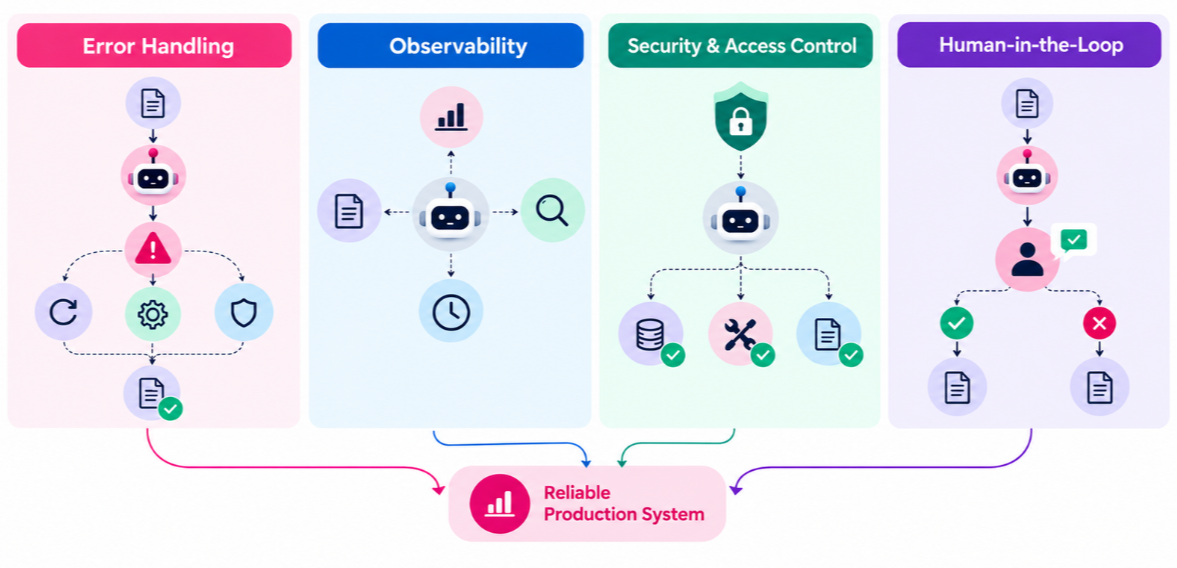
These architectures perform well in design documentation and controlled testing. What determines whether they perform well in production is the quality of a set of design decisions that are separate from the core architecture but directly affect how the system behaves when real inputs arrive in real volumes.
Error handling is the most important of these decisions. In a multi-agent workflow, an error in one agent can cascade through subsequent agents in ways that produce incorrect outputs without any obvious indication that something has gone wrong. Designing explicit error states, retry logic and fallback behaviors for every agent in the workflow before deployment is not optional in an enterprise context.
Observability is closely related. Being able to trace exactly what each agent received, what it decided, what it called and what it produced for any given task execution is essential for debugging failures, understanding performance degradation and satisfying the audit requirements that regulated industries impose. Logging and tracing infrastructure needs to be designed alongside the agent architecture rather than added after the fact, when a production issue makes its absence apparent.
Security and access control in multi-agent systems requires more careful design than in single-agent systems, because the attack surface is larger. Each agent has its own tool access, and each tool integration is a potential vulnerability if not properly secured. Agent permissions should follow the principle of least privilege. Each agent should have access only to the tools and data sources it needs for its defined role and nothing more.
Human-in-the-loop design determines where human oversight is inserted into the workflow. Not every step of a multi-agent workflow should run autonomously. High-stakes decisions, actions with significant external consequences and outputs that will be customer-facing without further review are all candidates for human approval gates within the automated flow.
Where Techasoft Fits In!
Techasoft is an agentic AI development company that builds multi-agent systems, AI agent orchestration and LLM-powered agents for enterprise clients. Our work spans financial planning agents, autonomous risk analysis and fraud detection in financial services, along with smart care management and healthcare data processing agents in healthcare.
We focus on connecting agentic AI solutions smoothly with your existing IT environment, including data warehouses, databases and business intelligence applications. Responsible AI is central to how we work. We implement AI governance frameworks to ensure transparency, reliability and compliance, and our systems are built for continuous optimisation and performance improvement over time.
With an experienced AI team, Techasoft supports enterprises building agentic AI systems at any stage, from early adoption to enterprise-scale autonomous deployments.
Get in touch with our team to discuss your multi-agent AI project.
Final Thoughts
Multi-agent AI is not an experimental architecture anymore. It is the pattern enterprises are using to automate workflows that single-model systems cannot handle reliably. Getting the architecture right requires deliberate design across orchestration, memory, tool integration, error handling, observability and security. All of this needs to be addressed before the first production workflow goes live, rather than reactively when problems surface under real operating conditions. The enterprises that invest in that design work upfront are building AI infrastructure that scales and improves over time. The ones that skip it are building systems that work in testing and fail at scale.
FAQs
1. What is the difference between a single AI agent and a multi-agent system?
A single AI agent handles a task within one model context using one set of capabilities and tools. A multi-agent system distributes a complex task across multiple specialized agents that collaborate, each contributing a specific capability to the overall workflow. Multi-agent systems handle longer, more complex tasks more reliably than single agents because the work is distributed across components optimized for their specific roles.
2. What is AI agent orchestration and why does it matter?
It's the coordination layer that manages how tasks are decomposed, how sub-tasks are routed to appropriate agents, how state is tracked across a workflow and how outputs are passed between agents. Without a well-designed orchestration layer, multi-agent systems become unpredictable in production because there is no reliable mechanism for managing the dependencies between agents.
3. How do enterprises handle errors in multi-agent workflows?
Well-designed enterprise multi-agent systems implement explicit error states, retry logic with configurable backoff, fallback behaviors that activate when primary agent paths fail and alert systems that notify human operators when automated error handling is insufficient. The specific design depends on the workflow and the consequences of different failure modes.
4. What observability tools are commonly used with enterprise multi-agent systems?
Common approaches include distributed tracing frameworks that capture agent-level execution detail, centralized logging systems that aggregate logs across all agents in a workflow, performance monitoring that tracks latency and throughput at the agent and workflow levels and custom dashboards that surface the operational metrics most relevant to the business workflow being automated.
5. How does Techasoft support enterprise multi-agent system development?
Techasoft builds multi-agent systems, AI agent orchestration and LLM-powered agents for enterprise clients, with a focus on financial services and healthcare use cases. This includes connecting agentic AI solutions to existing IT environments such as data warehouses, databases and business intelligence applications, along with AI governance frameworks to ensure transparency, reliability and compliance.

Post Comments