







Warehouse teams are asked to do two things that usually pull in opposite directions: pick faster and make fewer mistakes. Speeding up often introduces errors. Holding accuracy at high volume is harder still. Doing both while juggling seasonal demand, staff shortages and thousands of SKUs is the daily reality for most warehouse managers.
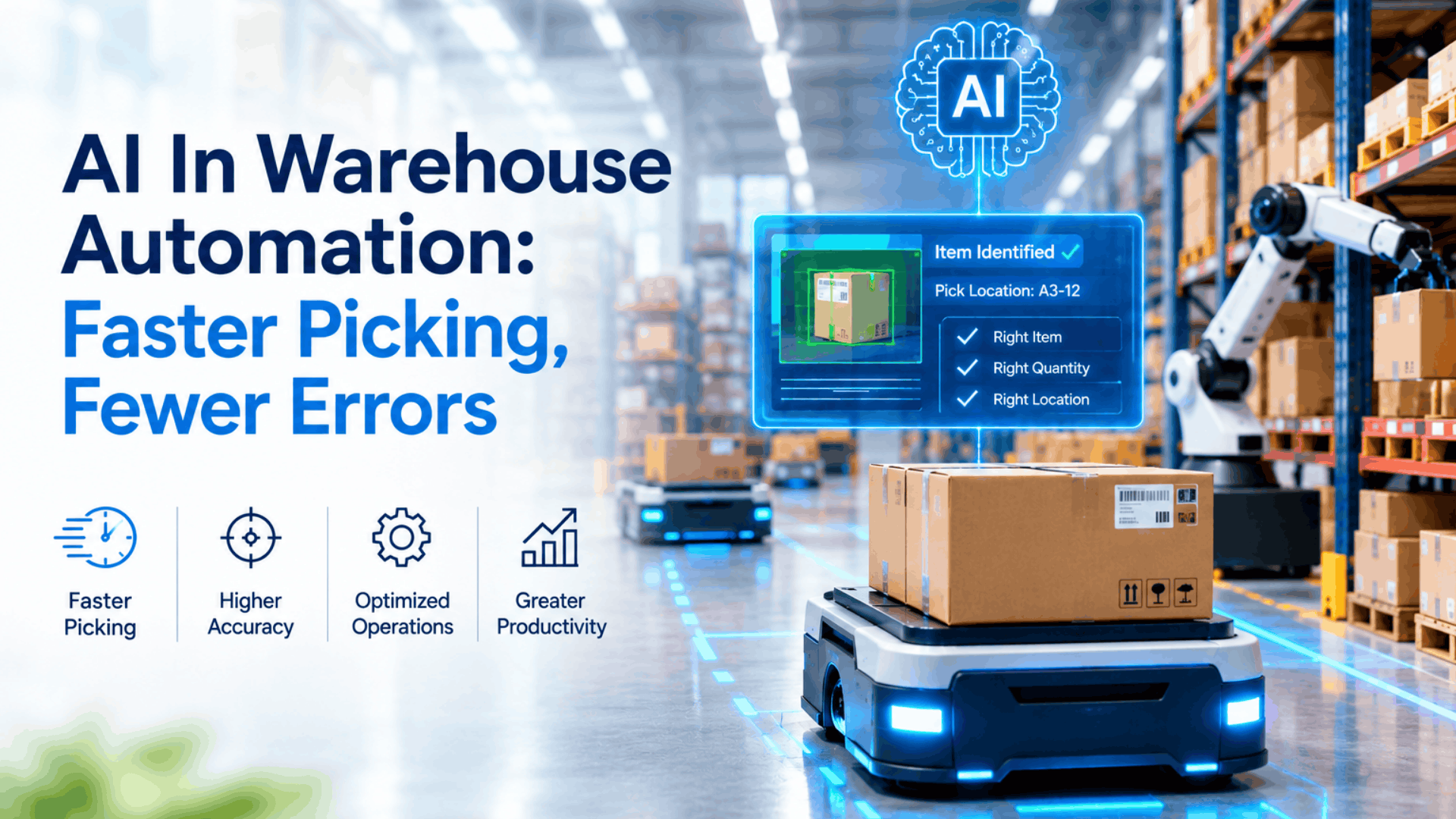
AI-powered warehouse automation changes the equation. Instead of replacing your operation, it adds intelligence to the decisions that cause delays and errors in the first place: where pickers walk, where stock sits, and how every order is checked before it leaves the dock. The outcome is a warehouse that gets faster and more accurate at the same time.
Key Takeaways
* AI shortens picking time by optimising pick paths, sequencing orders and guiding pickers straight to the right location.
* Vision-based verification at the pick and pack stages catches wrong items, wrong quantities and damaged goods before dispatch.
* Machine learning forecasting keeps fast-moving stock on the pick face before demand arrives, preventing delays upstream.
* AI works best as an intelligence layer on top of your existing WMS, ERP and hardware, not as a replacement.
* A true ROI calculation includes return costs, labour productivity and the impact of faster, accurate delivery on customer loyalty.
The Real Cost of Picking Errors
Most warehouses track their error rate. Far fewer track what each error actually costs, and that gap is where the business case for AI often hides.
Direct costs
* Return logistics: inbound shipping, inspection and repackaging for every wrongly picked order.
* Replacement fulfilment: picking, packing and shipping the correct item a second time.
* Customer service time: handling complaints, processing returns and issuing refunds.
Indirect costs
* Penalties: marketplaces and retail partners often charge for missing contractual accuracy targets.
* Lost repeat business: customers who receive the wrong order are less likely to buy again.
* Damaged reputation: reviews that mention wrong or broken items quietly lower future conversion rates.
When indirect costs are added to the picture, the error rate at which AI automation pays for itself is usually much lower than a simple logistics-cost comparison suggests.
Where Picking Speed Is Lost
Slow picking rarely has a single cause. It builds up from four distinct problems, and each needs a different fix.
Inefficient pick paths
Pickers who plan their own routes make choices that seem sensible in the moment but add up to wasted walking across a full shift.
Search time at the shelf
Even at the right bin, pickers lose seconds confirming the item, the quantity and the variant. In facilities with many similar-looking SKUs, those seconds multiply fast.
Congestion at popular locations
When several pickers reach the same fast-moving SKU at once, they queue. Without smart sequencing, congestion is handled after it happens instead of being prevented.
Outdated slotting
If fast movers are not stored closest to dispatch, every pick costs extra travel. Slotting decided when the facility opened drifts further from reality as products and demand change.
How AI Solves Each Problem
1. Intelligent pick path optimisation
AI calculates the most efficient route for picking a whole batch of orders at once. It considers the facility layout, where each item sits and where other pickers are in real time. Compared with static routes or zone picking, the result is less walking per order and more picks per hour, without asking anyone to move faster.
2. Vision-guided picking verification
Cameras at the pick location confirm that the right item, in the right quantity and condition, has been picked before the picker moves on. Wrong items, short picks and damaged units are caught at the shelf rather than at packing or, worse, at the customer's door. This is especially valuable where neighbouring products look almost identical.
3. Dynamic slotting with machine learning
Machine learning analyses order history, demand velocity, seasonality and which items are often bought together. It then recommends where each SKU should be stored. As demand shifts, the recommendations update, so your layout keeps pace with your product mix.
4. Demand forecasting for stock positioning
Many picking delays start before the pick: an item sitting in reserve, waiting for replenishment or missing from the pick face. Forecasting models predict what will be needed and in what volume, so stock is in position before orders arrive rather than replenished after delays begin.
5. Pack verification and dispatch checks
A final AI check at packing confirms order completeness, item condition and packaging integrity. Weight checks, barcode confirmation and camera-based damage detection work together as a last line of defence before anything leaves the building.
How AI Works With AMRs, Pick-to-Light, Voice Picking and RFID
AI does not compete with the warehouse technology you may already use. It makes that technology smarter.
* Autonomous mobile robots (AMRs): AI decides which robot goes where and in what order, reducing idle time and aisle congestion.
* Pick-to-light and put-to-light: Optimised order sequencing tells the lights which location to trigger next, cutting wasted movement between picks.
* Voice picking: AI-generated pick lists and routes are delivered as spoken instructions, keeping pickers hands-free and eyes-up.
* RFID: Tags provide real-time stock visibility, which feeds slotting and forecasting models with accurate location data instead of assumptions.
The common thread is data. Each of these systems generates information that AI can learn from, and each becomes more effective when AI directs it.
Integration With Your Existing WMS and ERP
A common worry is that AI means ripping out your warehouse management system. In practice, it connects to what you already run as an intelligence layer.
Typical integration points include:
* WMS: order data, inventory locations and pick confirmations.
* ERP: sales history, promotional calendars and procurement data for forecasting.
* Material handling equipment: conveyors, sorters and automated storage and retrieval systems, where present.
* Station hardware: scanners, cameras and weighing scales at pick and pack points.
How well these connections are designed decides how smoothly AI fits into the picker's day. A system that forces people to change how they work meets resistance, and that resistance limits results more than any technical shortfall.
How We Approach AI Warehouse Automation at Techasoft
At Techasoft, we design AI solutions for logistics operators, third-party logistics providers and manufacturers that run their own warehouses. As an experienced AI development company, we start with your floor, not with a template. Before proposing any technology, we study the specific error types and speed bottlenecks in your facility, then build systems calibrated to those problems and connected to your existing WMS and ERP.
Our capabilities span pick path optimisation, vision-guided verification, dynamic slotting, demand forecasting and pack verification, backed by our machine learning and industrial automation teams.
Proof from our projects
The building blocks of warehouse AI are already at work in our client projects:
* AI vision inspection on a production line: For an automobile manufacturer, we deployed an AI vision inspection system using four HD cameras and deep learning on NVIDIA GPUs to run around 32 checks per vehicle, with timestamped image evidence for every Pass or Hold decision. The same approach powers pick and pack verification in a warehouse.
* RFID bin counting and asset tracking: Our RFID Bin Counter and Asset Tracking work shows how real-time stock visibility can be automated, the foundation for accurate slotting and forecasting.
* Automated product inspection: Our Lubricant Bottle Inspection project applies computer vision to catch product defects at speed, similar to damage detection at dispatch.
Explore more of our work on the case studies page.
Conclusion
Faster picking and fewer errors are not a trade-off. In a well-designed AI system they are two results of the same thing: better decisions about routes, stock positions and verification, made in real time.
The warehouses that succeed with AI treat it as an operational problem with a technical solution, not a technology looking for a problem. Start with where your speed and accuracy are leaking, and let the AI be built around that.
Want to know where AI could save time and reduce errors in your warehouse? Talk to our AI team for an assessment of your picking and dispatch operations.
Frequently Asked Questions
1. What types of picking errors can AI reduce?
AI targets four common errors: picking the wrong item, picking the wrong quantity, choosing the wrong size, colour or variant, and dispatching a damaged unit. Camera checks at the shelf and the packing station catch these before an order ships.
2. Do I need to replace my warehouse management system?
No. AI connects to your current WMS, ERP and equipment and adds optimisation, forecasting and verification on top. Your team keeps the systems they already know.
3. What data is needed to get started?
Usually order history, SKU master data, current bin locations and a facility layout are enough to begin. Vision verification also needs sample images of correct and incorrect items, which can be collected during setup.
4. Can AI work alongside robots, pick-to-light or voice picking?
Yes. AI acts as the decision layer that directs these systems, telling robots where to go, lights which location to trigger and voice systems which instruction to give next.
5. How is dynamic slotting different from traditional slotting?
Traditional slotting is set once based on assumptions about which items sell fastest. Dynamic slotting uses live demand data to keep recommending better positions, so fast movers stay close to dispatch as your product mix changes.
6. How does Techasoft deliver AI warehouse projects?
We begin with an on-ground analysis of your bottlenecks and error types, then design, build, integrate and commission the solution end to end, drawing on proven computer vision and RFID work from our client projects.