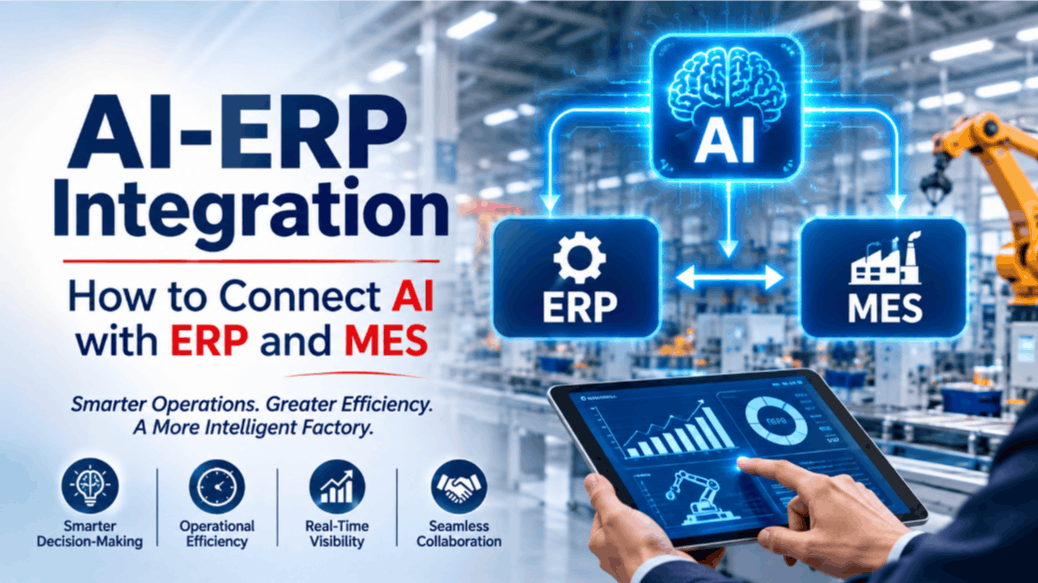

Walk into almost any factory and you'll find the same problem. The ERP system knows about orders, stock, costs and suppliers. The MES knows what's really happening on the floor: which machine is running, which one stopped, and how many parts failed inspection. But the two rarely share what they know. So when companies bring in AI, it ends up working with only half the story.
Quick answer: AI ERP integration means linking AI to your ERP (Enterprise Resource Planning) and MES (Manufacturing Execution System) so it can see both business data and live shop-floor data. Once they're connected, AI can spot problems early, predict what's coming and even take action in both systems. In practice, you agree on a common data model (usually ISA-95), pull machine data through OPC UA or MQTT, store everything in one data platform, and give AI secure access to ERP and MES through APIs.
Below, we'll walk you through what this looks like, why it's worth doing, and how to get it done step by step.
What Is AI ERP Integration?
Put simply, it's about making your ERP smarter by feeding it real data from the shop floor and adding AI on top. That AI could be machine learning that forecasts demand, generative AI that answers questions in plain English, or agentic AI that carries out tasks you've approved.
Think of it as three layers working together:
ERP plans the business. This could be SAP S/4HANA, Microsoft Dynamics 365, Oracle NetSuite, Odoo or a custom-built system.
MES runs production. It tracks work orders, work in progress, quality and traceability.
AI sits across both. It learns from the data, makes predictions and suggests (or takes) the next step.
Why ERP and MES Integration with AI Matters Now
Most big ERP vendors now offer built-in AI assistants. That's useful, but an assistant can only work with the data it can see. If your ERP doesn't know a machine has been down for three hours, its AI will happily plan a full shift on that machine.
Connecting MES data fixes that. It closes the gap between what you planned and what actually happened. That's the whole idea behind smart manufacturing and Industry 4.0, and increasingly Industry 5.0, where people and AI work side by side.
What You Gain by Connecting AI with ERP and MES
Fewer surprise breakdowns. With predictive maintenance, AI watches sensor data from machines and IIoT devices. When it sees signs of trouble, it can raise a maintenance order and request spare parts in the ERP before anything fails.
Plans you can actually hit. AI demand forecasting is checked against real machine capacity, so production schedules stop being wishful thinking.
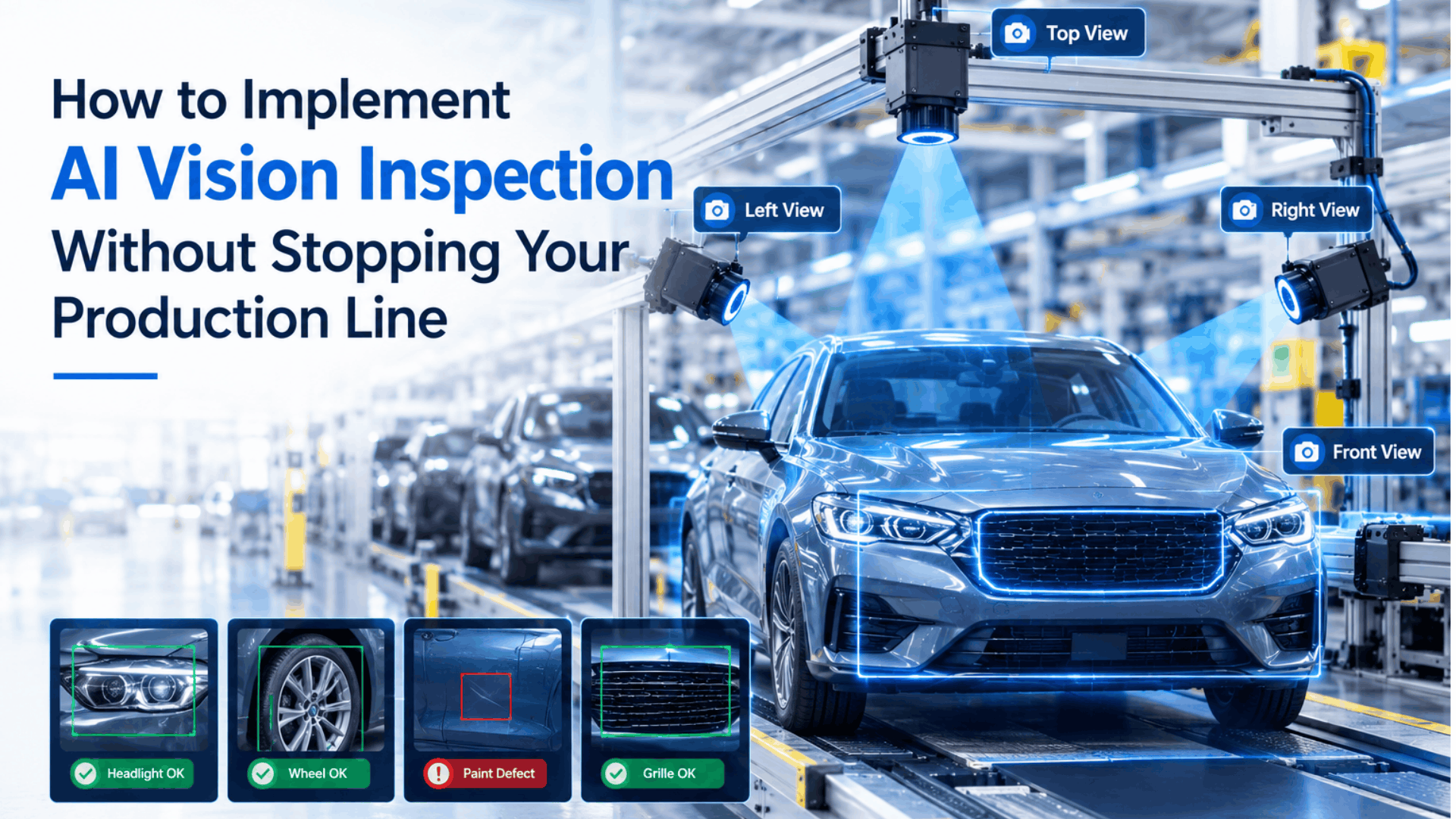
Quality problems caught early. Computer vision and anomaly detection flag defects as they happen, tie them to the right batch in the MES, and update cost and supplier records in the ERP.
Less money stuck in inventory. When purchasing follows real consumption, you run out less often and overstock less too.
Answers in plain English. A plant manager can ask a generative AI assistant, "Why did Line 3 miss its target yesterday?" and get an answer pulled from both systems.
Full traceability. Every order, batch and machine event is linked, which makes audits far less painful.
How to Connect AI with ERP and MES: Step by Step
There's no single right way to do this, but most successful projects follow a path like this one.
1. Start with one real problem. Don't try to "add AI" everywhere. Pick something that hurts, like unplanned downtime or late deliveries, and decide how you'll measure success (OEE, scrap rate or forecast accuracy).
2. Take stock of what you have. Note your ERP and MES versions, the APIs they offer, where the data lives and who owns it. Is your ERP in the cloud or on-premise? Can your MES connect to modern tools?
3. Get both systems speaking the same language. Map orders, materials, equipment and people to the ISA-95 standard so ERP and MES data line up.
4. Connect the shop floor. Use OPC UA and MQTT to pull data from PLCs, SCADA and sensors. A lot of manufacturers now set up a Unified Namespace (UNS), a single real-time hub where every system shares its data.
5. Bring the data together. Move ERP and MES data into one platform, such as a data lakehouse. Clean it up and add context. AI is only as good as the data you give it.
6. Build and train your AI models. Use machine learning for forecasting and predictive maintenance, computer vision for quality checks, and large language models (LLMs) with retrieval-augmented generation (RAG) for plain-English answers.
7. Let AI talk to your systems safely. Wrap key actions, like creating a work order or updating stock, in secure APIs. Newer standards such as the Model Context Protocol (MCP) make it easier for AI agents to use these tools without going off script.
8. Run AI where it makes sense. Put fast, time-critical models on edge devices near the machines. Keep heavier analysis in the cloud.
9. Keep people in charge at first. Let AI make suggestions that a planner approves. Hand over more control only once it has earned trust.
10. Measure, improve, repeat. Track results, retrain models regularly (MLOps), then roll out to more lines and plants.
Ways to Integrate AI with ERP and MES
There are four common approaches, and many companies end up using a mix of them.

How different industries use it:
Automotive and auto parts: Production gets rescheduled around real machine availability and supplier delays.
Pharma and FMCG: Batch data from the MES helps AI predict quality issues before a batch is released.
Electronics: Cameras inspect circuit boards and link any defects to component lots in the ERP.
Engineering goods: Digital twins test line changes virtually, then push the best plan back to the ERP.
Common Challenges (and How to Handle Them)
Let's be honest: this isn't plug and play. Here's what usually gets in the way.
Messy data. Different material codes in different systems, or missing timestamps, can throw AI models off.
Old systems. Legacy MES or on-premise ERPs often don't have modern APIs.
Security risks. Connecting the shop floor to the cloud opens new doors for attackers.
People. Operators and planners won't follow AI advice they don't understand or trust.
What works:
* Run a small pilot on one line, prove it pays off, then scale.
* Stick to open standards like ISA-95, OPC UA and MQTT so you're not locked into one vendor.
* Use zero-trust security, role-based access and logs for every action AI takes.
* Set clear AI rules on transparency, data privacy and compliance, including India's DPDP Act where personal data is involved.
* Train your teams so AI feels like a helpful co-pilot, not a mystery box.
How Techasoft Can Help
Techasoft is an ERP software development and AI solutions company based in Bengaluru, India. We help manufacturers connect their systems and put their data to work. Our team includes ERP consultants, AI and machine learning engineers, and IIoT specialists, so we can handle the whole journey, not just one piece of it.
Here's what we do:
* Custom ERP development and integration for SAP, Dynamics 365, Odoo and custom ERPs
* MES integration using OPC UA, MQTT and Unified Namespace
* AI and generative AI solutions, from predictive maintenance and demand forecasting to AI copilots
* Agentic AI workflows that safely automate tasks across ERP and MES
* Cloud and edge AI deployment, plus ongoing MLOps support
Want to see what this could look like in your plant? Talk to our AI ERP integration team for a free consultation and a roadmap built around your needs.
Frequently Asked Questions
What's the difference between ERP and MES?
ERP handles the business side: finance, purchasing, inventory and sales. MES handles production on the shop floor: work orders, machine performance and quality. An easy way to remember it: ERP decides what to make, and MES makes sure it gets made.
Why connect AI with ERP and MES?
Because AI needs the full picture to be useful. With both business and production data, it can forecast demand more accurately, predict machine failures, catch quality issues early and help you make faster decisions.
Which protocols are used for ERP MES integration?
The usual ones are ISA-95 for organizing data, OPC UA and MQTT for connecting machines, and REST or GraphQL APIs for talking to the ERP. Many plants use a Unified Namespace to tie it all together.
Can AI work with an old ERP system?
Yes. You don't always need to replace your ERP. Middleware, API wrappers and data platforms can connect AI to older on-premise systems.
How long does an AI ERP integration project take?
A pilot focused on one problem usually takes a few months, depending on how ready your data and systems are. Plant-wide rollouts are done in phases after that.
What is agentic AI in ERP?
Agentic AI means AI agents that can plan and carry out tasks with several steps. For example, if a machine breaks down, an agent could reschedule production and update ERP orders, all within limits your team sets.