







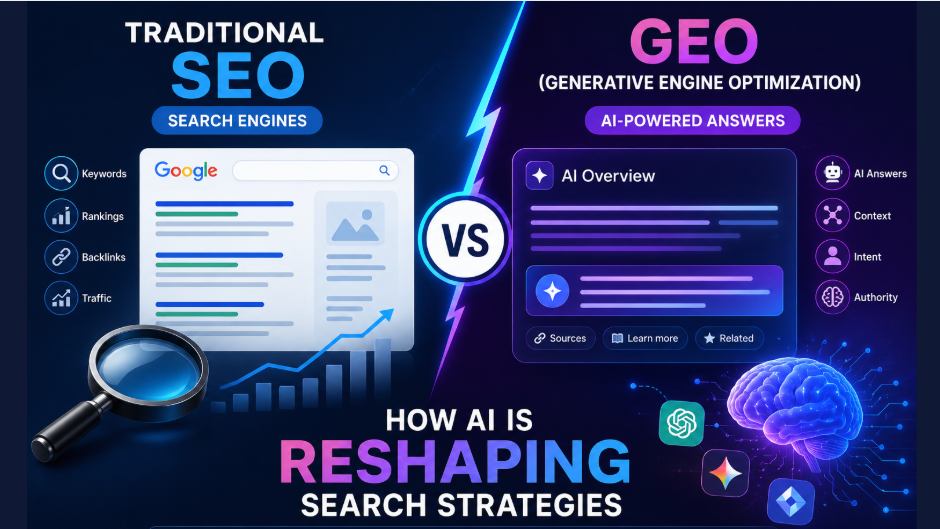

If you've been doing SEO for a while, you've probably noticed something strange happening. Your rankings might look fine. Your traffic? Not so much.
That's because the way people search and the way they find answers has fundamentally changed. AI-powered tools like ChatGPT, Google's AI Overviews, Perplexity, and Claude are answering questions directly. Users aren't always clicking on ten blue links anymore. In many cases, they're getting their answer without ever visiting a website.
This shift has given rise to a new discipline: Generative Engine Optimization (GEO) and it's changing how smart brands think about visibility online.
Let's break down what traditional SEO and GEO actually are, how they differ, and what your business needs to do to stay visible in this new era of AI-driven search.
What Is Traditional SEO?
Traditional SEO is the practice of optimizing your website so it ranks higher on search engine results pages (SERPs), primarily Google. The goal is simple: show up when someone searches for something relevant to your business.
The key tactics include:
* Keyword research -- finding the terms your audience types into search engines
* On-page optimization -- structuring your title tags, H1s, meta descriptions, and content around those keywords
* Link building -- earning backlinks from other websites to build domain authority
* Technical SEO -- ensuring your site is crawlable, fast, and mobile-friendly
* Content creation -- publishing articles and pages that match search intent
Traditional SEO has been the backbone of digital marketing for over two decades. It's measurable, scalable, and when done right, generates compounding returns over time.
But here's the challenge: nearly 60% of searches now end without a click. People get what they need directly on the results page, through featured snippets, knowledge panels, or increasingly, AI-generated summaries.
Traditional SEO still matters. But it's no longer enough on its own.
What Is GEO - Generative Engine Optimization?
GEO, or Generative Engine Optimization, is the practice of optimizing your content and brand presence so that AI language models and generative search engines cite, recommend, or reference you in their responses. Many businesses are now investing in generative engine optimization services to improve their visibility across AI-powered search experiences.
Think of it this way: when someone asks ChatGPT "Who are the best Shopify Plus agencies for B2B eCommerce?" -- you want your brand to be in that answer.
GEO works hand in hand with answer engine optimization (AEO) -- the practice of structuring content to appear in direct answer boxes, voice search results, and AI-generated summaries. While answer engine optimization zeroes in on specific structured placements, GEO takes a broader view: ensuring your brand is part of the AI's training signals, citation patterns, and knowledge base.
How Generative Engines Work Differently
Traditional search engines crawl and index pages, then rank them based on relevance and authority. Generative engines do something different: they synthesize information from multiple sources and generate a new, consolidated response.
That means:
* Your content needs to be citable and factual, not just keyword-optimized
* Brand mentions across third-party sites matter more than ever
* Structured data helps AI models understand what your page is actually about
* Authority signals like reviews, citations, and expert quotes feed directly into AI confidence
If Google's algorithm is a popularity contest, think of AI models as a research panel. They look for consensus, credibility, and clarity.
Traditional SEO vs GEO: Key Differences
|
|
Traditional SEO |
GEO + Answer Engine Optimization |
|
Goal |
Rank in search results |
Be cited/referenced by AI |
|
Primary focus |
Keywords and backlinks |
Authority, clarity and structure |
|
Success metric |
Rankings and organic traffic |
AI mentions and branded queries |
|
Content format |
Long-form keyword-targeted pages |
Concise, factual, structured content |
|
Key signals |
PageRank, backlinks, CTR |
Reviews, citations, E-E-A-T signals |
|
Audience |
Search engine bots + humans |
AI models + humans |
|
Timeline |
3 to 6 months to see results |
Ongoing, compounds over time |
Why the Two Need to Work Together
Here's a mistake a lot of brands are making: treating GEO as a replacement for traditional SEO. It isn't. It's an expansion.
Traditional SEO still drives the majority of clickable web traffic. A high-ranking blog post or service page directly brings visitors who convert into leads. That's not going away, which is why many businesses continue to rely on SEO services alongside emerging AI optimization strategies.
But GEO addresses a growing blind spot: AI-generated responses that your traditional SEO efforts can't capture.
If someone asks Perplexity.ai a question and your competitor gets cited but you don't, that's a lost opportunity that no amount of keyword optimization will fix. You need both strategies running in parallel.
The brands winning right now are the ones building what you might call a "search + AI" presence -- optimized for both traditional crawlers and generative models. That's exactly what generative engine optimization services are designed to help with: closing the gap between where your brand ranks and where it actually gets seen.
How to Optimize for Generative AI: Core GEO Principles
1. Establish Clear E-E-A-T Signals
E-E-A-T stands for Experience, Expertise, Authoritativeness, and Trustworthiness. Google introduced this framework, but it's become even more critical for AI visibility. AI models are trained to favor sources that demonstrate real-world credibility.
Practical steps:
* Add author bios with verifiable credentials to your content
* Publish original research, case studies, and data
* Get quoted in industry publications and news outlets
* Build a consistent brand presence across platforms
2. Use Schema Markup and Structured Data
AI models rely heavily on machine-readable signals to understand context. Without structured data, your content is harder to parse and less likely to be cited accurately.
Implement:
* FAQPage schema -- signals clear Q&A content that AI can extract
* Organization schema -- establishes your brand identity for knowledge graphs
* Article schema -- marks up blog posts and guides
* Review/Rating schema -- surfaces social proof that feeds AI confidence
3. Create "Answer-First" Content
Traditional SEO content often buries the lead. GEO-optimized content does the opposite: it answers the question directly in the first paragraph, then expands.
Think of how Wikipedia is structured. The opening paragraph gives a concise, definitive answer. AI models love this format because they can extract and cite it cleanly.
When writing new content:
* Lead with a crisp one-paragraph answer
* Follow with supporting detail, context, and nuance
* Use clear H2/H3 headings that mirror real questions people ask
* Avoid filler and throat-clearing introductions
4. Build a Strong Third-Party Mention Footprint
One of the biggest drivers of AI visibility is how often your brand appears across the web, not just on your own website. This includes reviews on G2, Clutch, or Trustpilot, mentions in trade press, guest articles, podcast appearances, and analyst citations.
AI models synthesize public information. The more consistently your brand shows up as a credible source across multiple independent platforms, the more likely you are to be referenced in AI responses.
A strong reputation is worth a lot here -- but only if it's distributed across the web, not just sitting on your own homepage.
5. Optimize for Conversational Queries
Traditional SEO targets short keywords like "Shopify B2B development agency." GEO targets the way people actually talk to AI tools: "Which agency should I hire to build a b2b ecommerce development ERP integration?"
These are longer, more specific, intent-rich queries. Map your content to real questions your buyers are asking -- not just the compressed keywords a search engine would parse.
Tools like People Also Ask, Reddit threads, and sales call transcripts are gold for finding these conversational patterns.
6. Implement an llms.txt File
This is an emerging technical signal that many brands are still ignoring. An llms.txt file (similar in concept to robots.txt) tells AI crawlers how to interact with your site -- what to index, what to prioritize, and how your content is structured.
It's not yet universally adopted, but early movers are already benefiting from being AI-crawler-friendly before it becomes the norm.
How Answer Engine Optimization Fits Into This
A lot of people ask where answer engine optimization (AEO) sits within this picture. The honest answer: it's already baked into a solid GEO strategy.
When you structure content to answer questions clearly, add FAQ schema, and write with a direct "answer-first" format, you're doing answer engine optimization. You're making it easy for both AI tools and search engines to extract a clean, citable response from your page.
The distinction matters less than the practice. Whether you call it AEO or GEO, the goal is the same: be the source that gets cited when someone asks a question your business can answer. For businesses that want a head start, investing in AEO services is one of the faster ways to build that structured, answer-ready presence across your key topics. The brands that do this well build a compounding presence that traditional keyword rankings alone can't replicate.
The Real Business Case: Why This Matters Now
AI-generated overviews now appear in the vast majority of search queries in some form. That's not a future trend. It's the current reality.
And the brands that establish AI visibility today -- through structured data, citation footprints, E-E-A-T signals, and generative engine optimization -- will have a compounding advantage over brands that wait until AI search dominance is undeniable.
Early movers in SEO built domain authority that took competitors years to match. The same dynamic is playing out in the AI visibility space right now.
Final Takeaway
Traditional SEO helps your website rank. GEO helps your brand appear in AI-generated answers.
Both are now important.
As AI reshapes search behavior, businesses need to think beyond keywords and rankings. They need to build helpful content, strong authority, clear expertise, and a trustworthy brand presence across the web.
SEO brings users to your website. GEO helps your brand become part of the answer.
For businesses that want long-term visibility, the smartest approach is not choosing between SEO and GEO. It is combining both into one search strategy built for how people actually search today.




Post Comments