







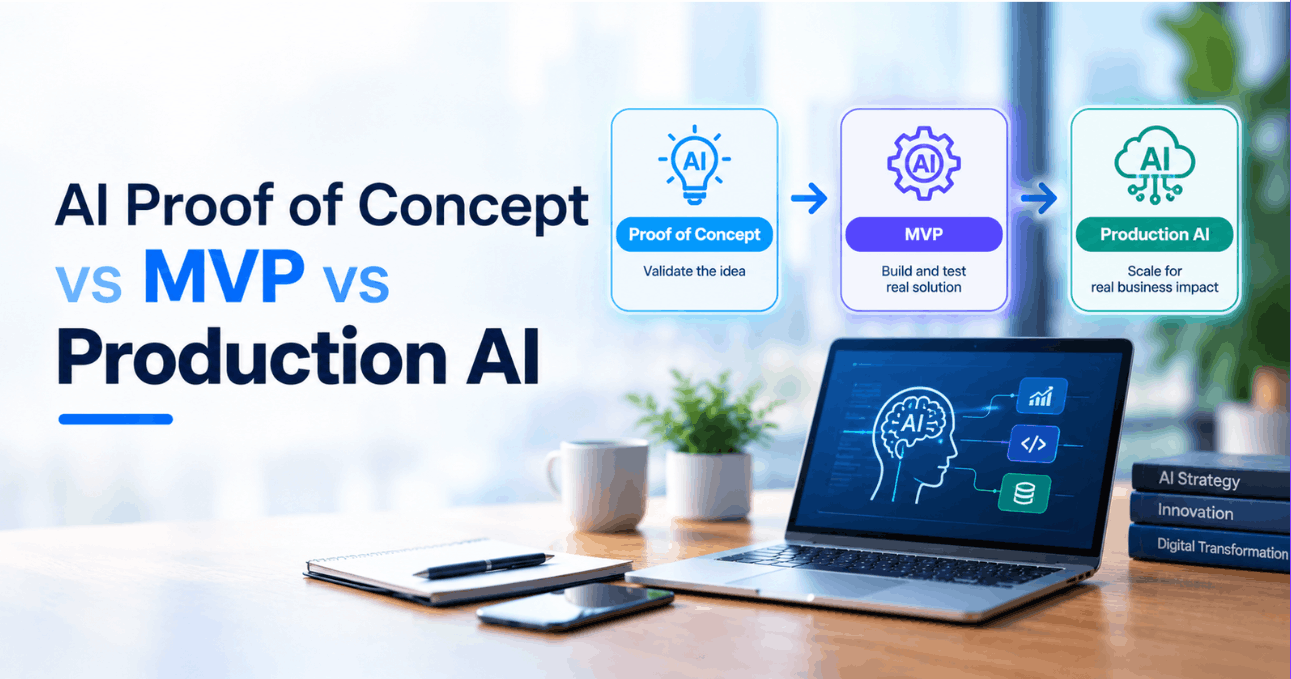

Most businesses approaching AI for the first time run into the same challenge. They know they want to use AI in a meaningful way, but they are not sure where to start, how much to invest upfront or how to avoid spending a significant budget on something that turns out not to work in their specific operational context. The question of AI Proof of Concept vs MVP vs Production AI really comes down to how much you should invest before you know whether the idea will work in practice. Making the right choice at this stage can save a business significant time and money later.
Key Takeaways
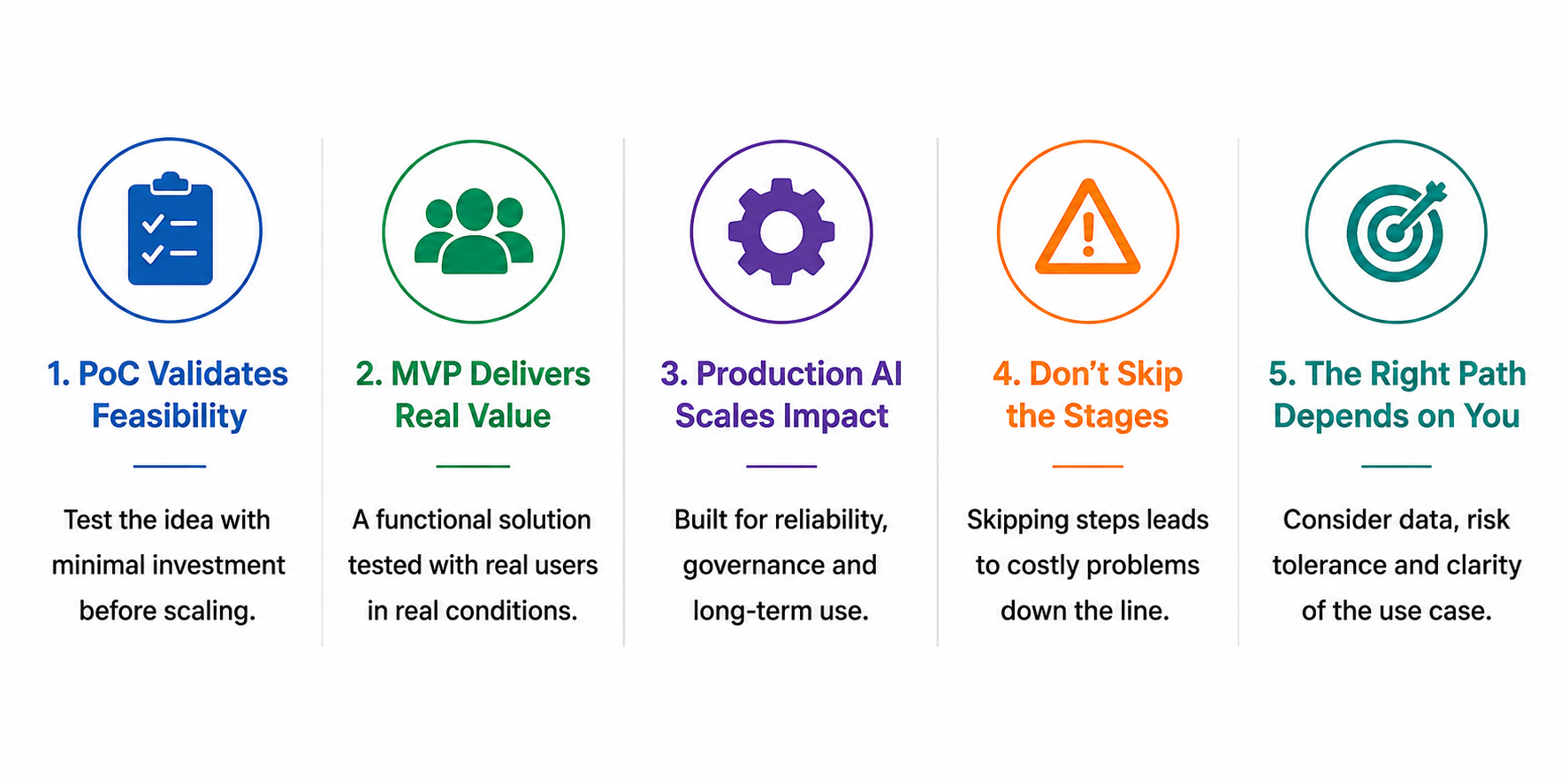
* An AI PoC validates technical feasibility with minimal investment before broader development begins.
* An AI MVP delivers a functional solution with core features that can be tested with real users in a real environment.
* Production AI is a fully scaled, governed and integrated system built for sustained operational use.
* Skipping stages to reach production faster almost always creates more expensive problems than the time saved was worth.
* The right path through these stages depends on data readiness, business risk tolerance and the clarity of the use case.
What is an AI Proof of Concept?
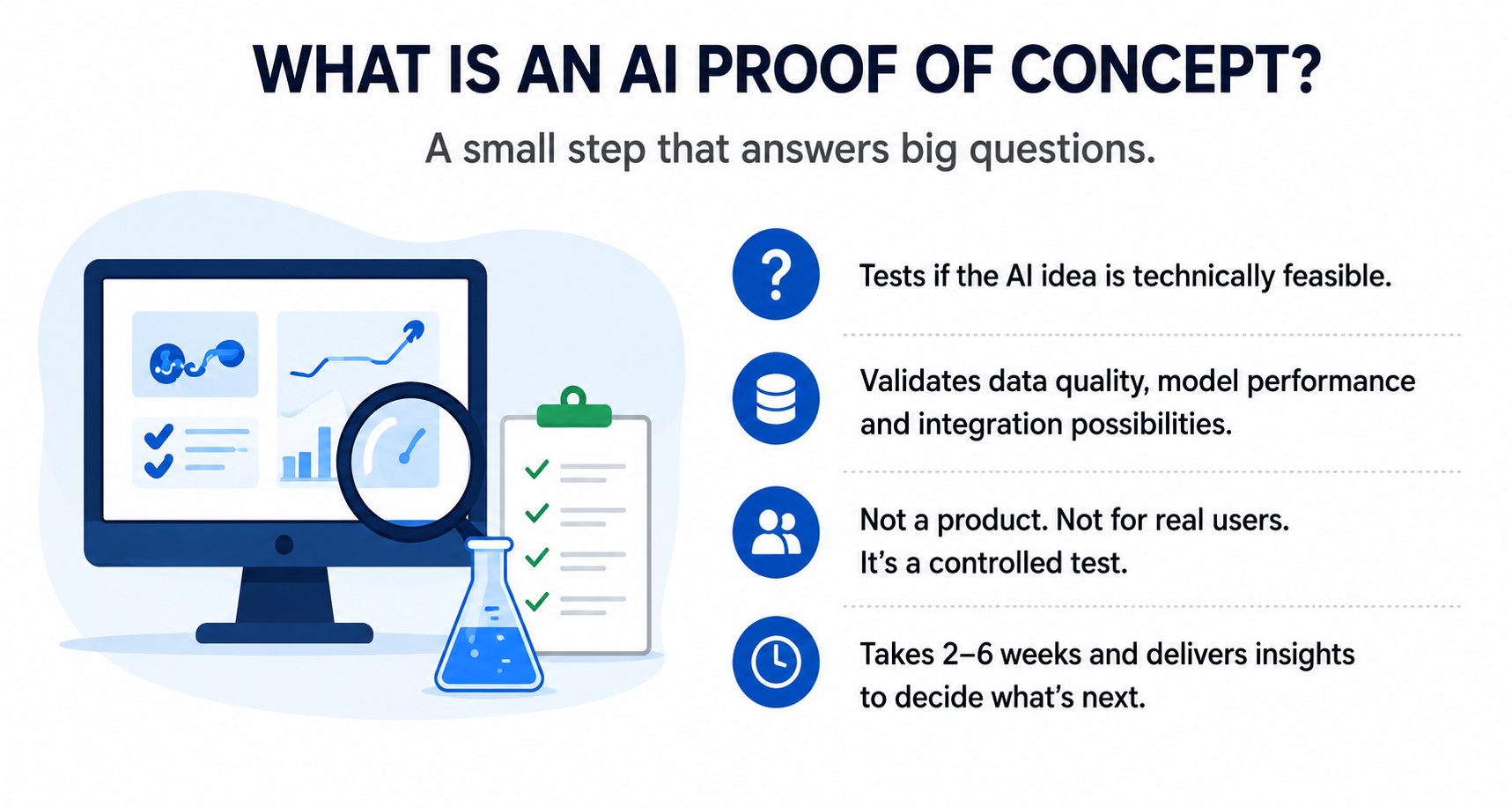
An AI Proof of Concept is a small, focused project used to test whether an AI idea is actually feasible before committing to a larger development effort. Can this AI approach actually work with our data, in our context, at a level of performance that would make it useful?
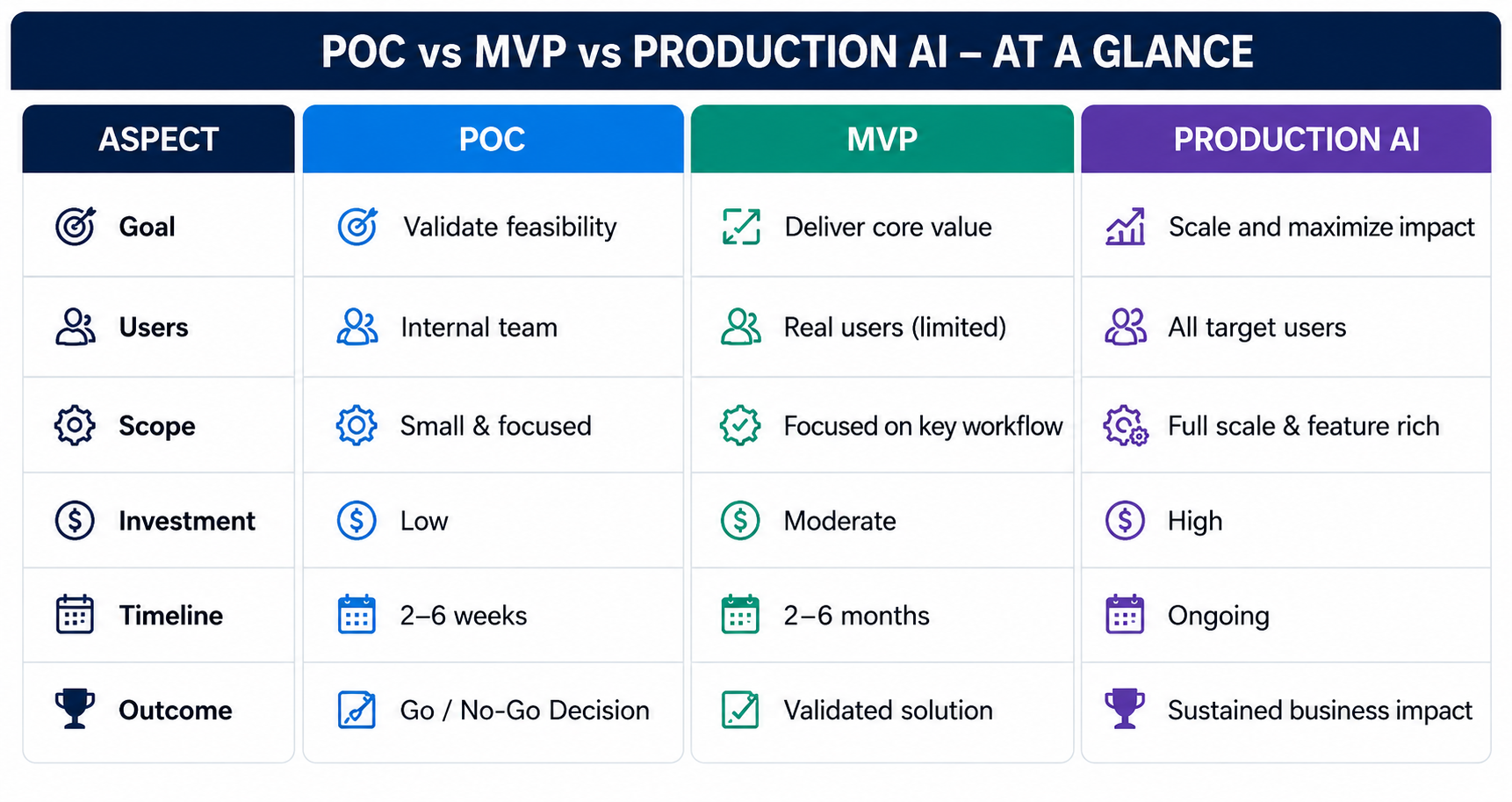
A PoC is not a product. It is not intended for real users or production workloads. It is a controlled test that surfaces the technical and data-related obstacles that would otherwise only be discovered halfway through a much larger development effort. A typical AI PoC takes two to six weeks and produces a working demonstration of the core AI capability along with an honest assessment of what would be required to take it further.
The real value of a PoC is the information it provides. It can show whether the available data is good enough, whether the chosen approach performs well on representative inputs and whether the integrations needed for a larger implementation are technically possible. Without this, decisions about whether to proceed get made on assumption rather than fact and that consistently produces more expensive outcomes than a well-scoped PoC would have.
When to Build an AI PoC
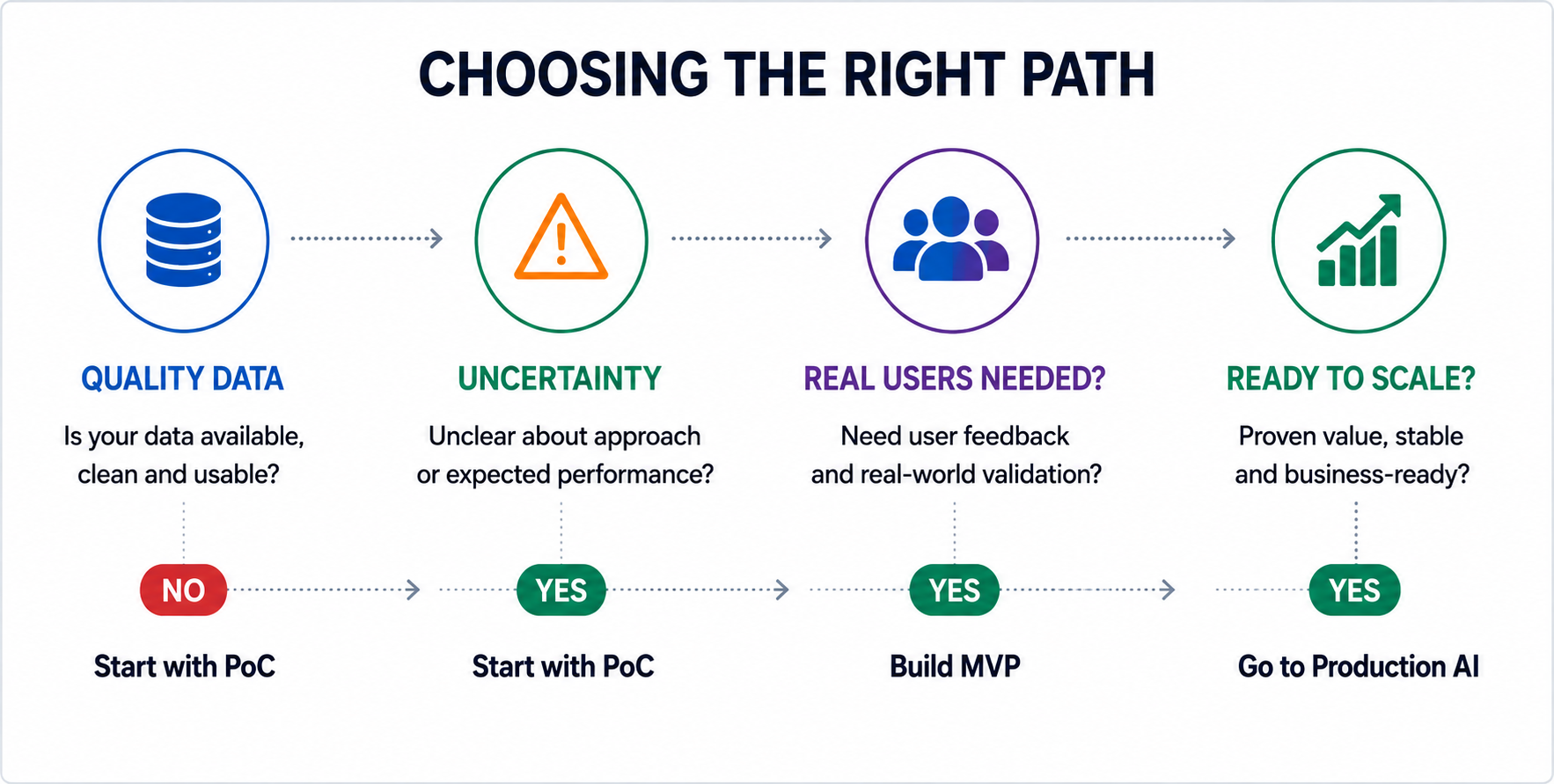
Not every AI initiative needs a PoC and not every PoC is worth building. A PoC is most useful when there is still uncertainty around the technical approach, the quality of the available data or the level of performance the model can achieve. It can help answer these questions before the business commits a larger budget to development.
If the use case is well-established, the data is clean and available and the team has delivered comparable AI systems before, the PoC stage may be abbreviated or combined with early MVP development. If any of those conditions is missing, a PoC can help uncover the gaps before the business commits its full development budget.
AI MVP Development
Once a PoC has established that the core AI approach works, the next stage is building something that real users can actually interact with in a real environment. That is what AI MVP development produces. An MVP is a functional solution with enough features to provide real value to a specific group of users. It also gives the business a chance to see how the system performs in practice and what needs to change before a full production rollout.
The difference between a PoC and an MVP is particularly important in AI because a model can perform well in testing but behave differently when real users and real-world data are introduced. Real user behavior, production data distributions and the edge cases that only appear at scale all affect how a model performs in ways that a PoC environment cannot fully replicate. An MVP exposes those factors while the system is still small enough that adapting to what they reveal is relatively inexpensive.
A well-scoped AI MVP should have clear success criteria from the start. It should focus on one primary workflow rather than trying to solve several problems at once, use real data wherever possible and have a clear way of collecting user feedback and measuring performance.
Production-Ready AI Development
Production-ready AI development is what happens after an MVP has validated that the AI delivers genuine value at a meaningful level of reliability and that the business is ready to invest in scaling it. Production AI is a fully integrated, governed and monitored system built to operate reliably at the scale and across the user base the business actually needs to serve.
Production AI requires much more than a working model. The system needs ongoing model monitoring, retraining processes, reliable integrations and the infrastructure needed to handle real production volumes. Depending on the business and industry, it may also need governance and compliance controls to ensure the system remains auditable and reliable over time.
AI PoC to MVP Roadmap
Moving from PoC to MVP is not simply a matter of adding features to the prototype. It typically requires rebuilding the core system on a more robust architecture because prototypes are built to test ideas quickly rather than to support the reliability, integration and monitoring requirements of a production-adjacent environment.
The AI PoC to MVP roadmap should cover the key steps needed to turn the prototype into a usable product. This can include productionising data pipelines, setting up model retraining and versioning, developing the user interface, connecting the system to existing tools and defining how success will be measured. Techasoft's Artificial intelligence and machine learning practice supports clients through this full transition, ensuring the PoC learning is carried forward into an MVP architecture that can support the next stage rather than creating technical debt that slows it down.
AI Project Stages for Business
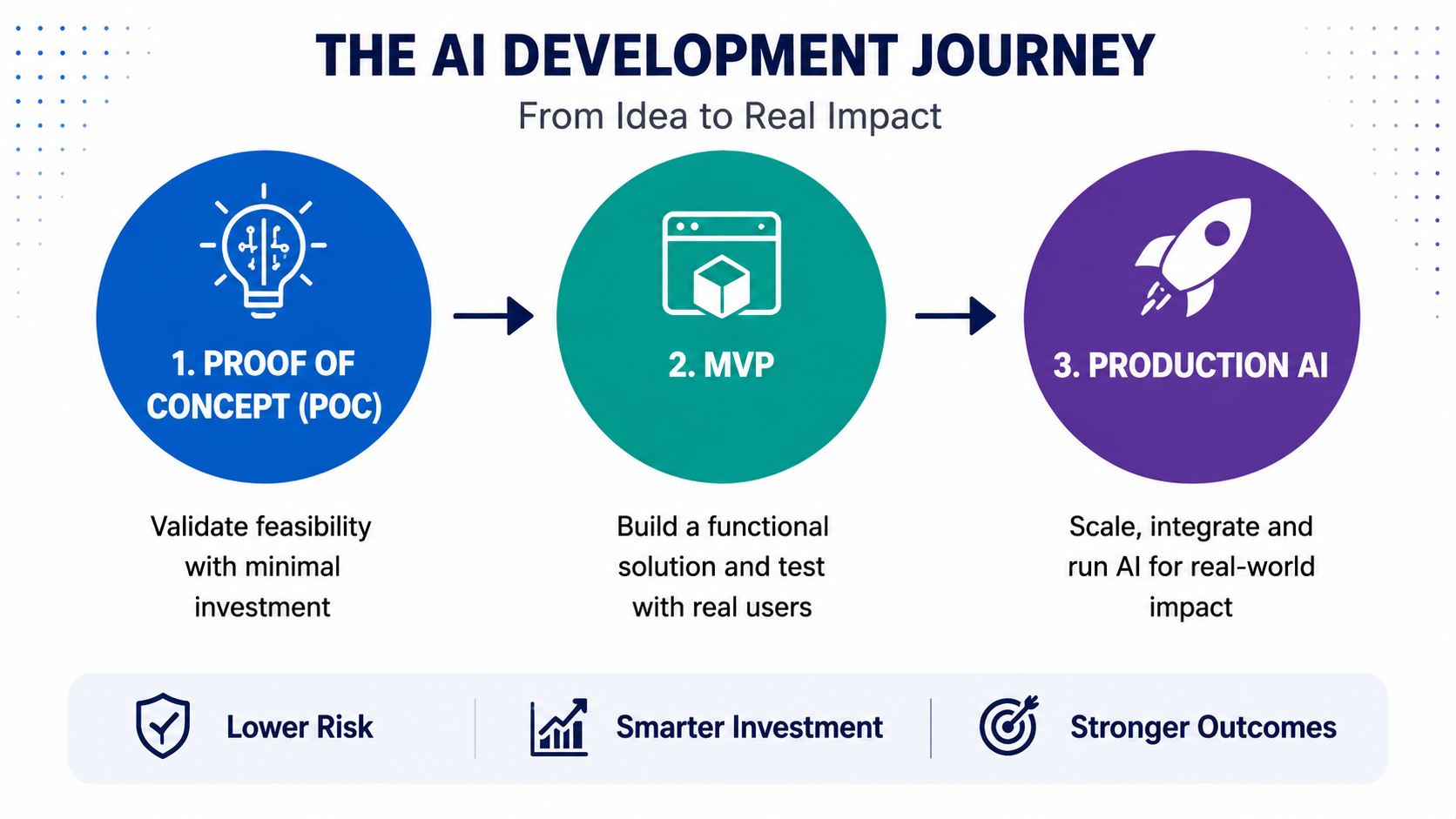
Understanding AI project stages for business helps organizations make better resource and timeline decisions at each point in the development journey. The three stages, PoC, MVP and production, are not simply smaller and larger versions of the same activity. They answer fundamentally different questions and require different levels of investment, different technical approaches and different organizational readiness.
The three stages answer different questions. A PoC tests whether the AI approach can work. An MVP tests whether it provides useful results for real users. Production AI takes that validated solution and makes it reliable, scalable and suitable for wider business use. Each answer needs to be genuinely established before the next investment is committed.
AI Development Lifecycle Stages
The AI development lifecycle stages that Techasoft supports span the complete journey from initial feasibility through to sustained production operation. That includes the PoC work needed to validate technical approach and data readiness, the MVP development that produces a real-world validated solution, the production build that scales and governs the system for full organizational deployment and the ongoing monitoring and optimization that keeps production AI performing well as conditions evolve.
How to Scope an AI Project
Scoping an AI project requires being specific about four things before any development begins. What outcome the AI is being built to improve and how that improvement will be measured, what data is available to support the chosen approach and what its current quality and accessibility looks like, what the acceptable level of model performance is for the system to be useful rather than simply interesting and what the integration requirements are for the system to operate within the environment it is being built for.
Defining these areas early makes it easier to choose the right starting point, set realistic expectations and decide when the project is ready to move to the next stage.
AI PoC vs MVP: Which Should Your Business Build First?
The honest answer to AI PoC vs MVP depends on how much is already known about the feasibility of the specific approach in the specific context. If significant uncertainty exists around data quality, model performance or technical approach, a PoC is the right starting point. If comparable implementations exist and the primary unknown is how users will interact with the system in a real operational environment, an MVP may be the appropriate first stage.
What is almost never the right answer is attempting to go directly to production without the validation that a PoC and MVP provide. Many problems that appear after a system reaches production could have been identified earlier through better validation of the data, model performance and operational requirements.
FAQs
1. How long does an AI PoC typically take?
A focused AI PoC typically takes between two and six weeks depending on the complexity of the use case and the readiness of the data required to support it.
2. What is the difference between an AI PoC and an AI MVP?
A PoC validates that the core AI approach is technically feasible with the available data. An MVP is a functional solution built for real users in a real environment that generates the feedback needed to inform production development.
3. When is it appropriate to move from MVP to production AI?
When the MVP has demonstrated genuine value at a measurable level, when the user feedback has been incorporated and when the business is ready to invest in the governance, monitoring and integration infrastructure that production AI requires.
4. Does Techasoft support the full AI development journey from PoC to production?
Yes. Techasoft's AI and machine learning practice covers the complete development lifecycle from initial feasibility assessment through PoC development, MVP build, production deployment and ongoing model monitoring and optimization.
5. What happens if a PoC does not produce the expected results?
A PoC that surfaces technical or data-related obstacles that make the intended approach unviable is still a successful PoC. It has prevented a significantly larger investment from being made in a direction that would not have produced the intended outcome, which is precisely what the PoC stage exists to do.

Post Comments