







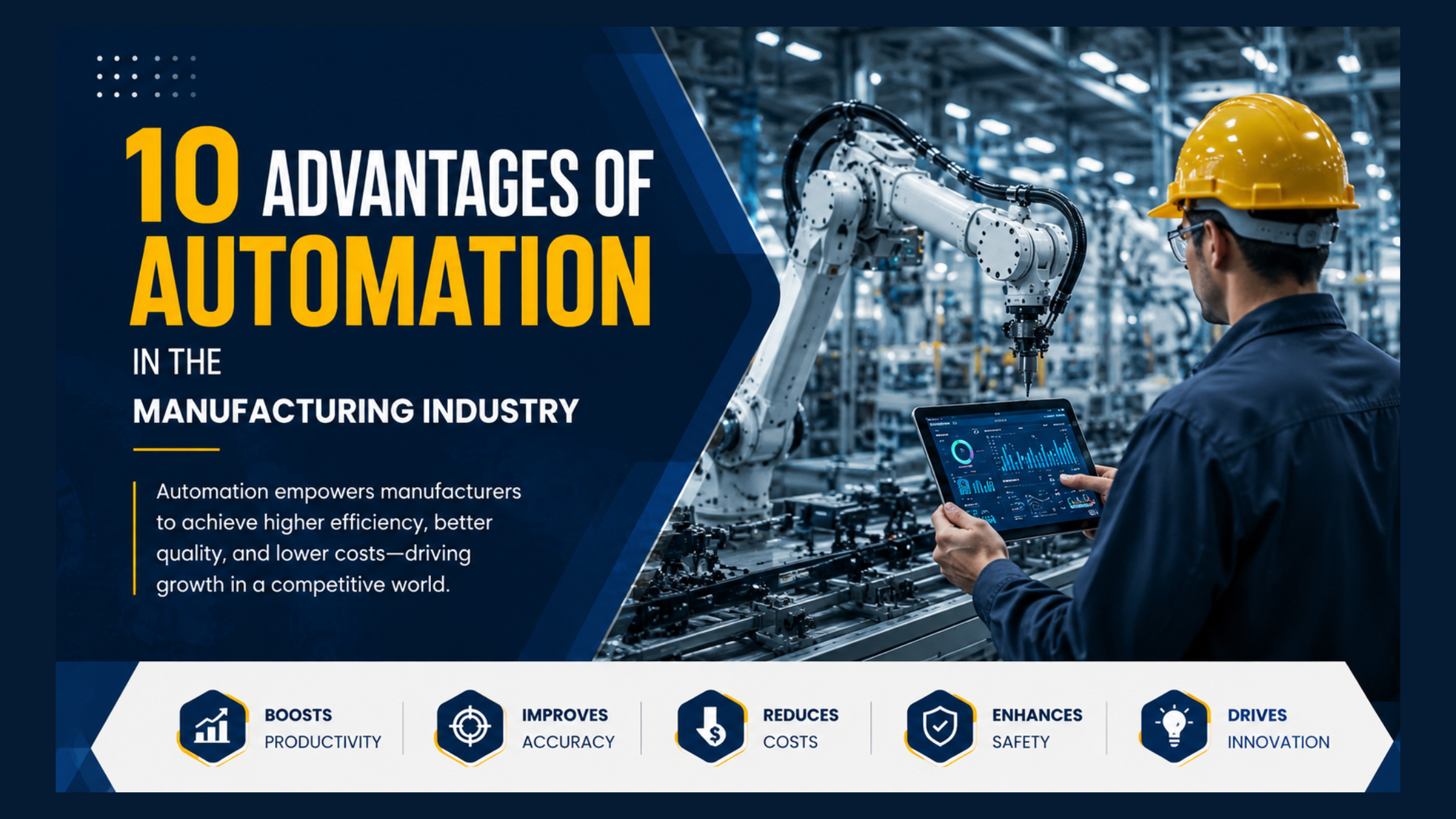

Ask anyone who has spent real time running a manufacturing operation and they will tell you that the problems that cost the most are rarely dramatic. They are the quiet, persistent ones, such as the errors that accumulate across thousands of repetitive cycles. Manufacturing automation addresses these problems in ways that manual processes genuinely cannot and the intelligence built into modern industrial automation systems makes the advantages considerably more significant than most manufacturers who evaluated automation a decade ago and moved on would expect.
Advantages of Automation in the Manufacturing Industry
1. Significantly Higher Production Output
Modern automated manufacturing systems increase production output while maintaining consistent production speeds and improving overall manufacturing efficiency. A production line running with well-implemented automation operates continuously at a pace and consistency that human-operated processes simply cannot sustain across an extended period. For manufacturers competing on volume and delivery reliability this is not a marginal improvement. It is the kind of operational advantage that shows up clearly in the numbers and compounds meaningfully over a full production year.
2. Dramatically Reduced Error Rates
Human error in manufacturing is not a workforce quality problem. It is what inevitably happens when people are asked to perform highly repetitive, precision-dependent tasks under conditions that make sustained concentration genuinely difficult over time. The inspector who checked the first hundred units of a shift is not operating identically when checking the five hundredth. Automated systems applied to those same tasks perform them with a consistency that manual processes cannot replicate at scale regardless of how well the workforce is trained or how carefully the process is documented.
3. Lower Operational Costs Over Time
The upfront investment in manufacturing automation gives many organizations pause and understandably so. What tends to get underestimated in that evaluation is what happens to operational costs once automation is properly in place. Labor costs associated with repetitive tasks, rework expenses from quality failures, material waste and the administrative overhead of managing complex manual workflows all reduce in ways that compound over the operational life of the system. Techasoft's AI manufacturing solutions and machine learning capabilities help manufacturers accelerate this cost reduction by adding intelligent decision-making to automation that would otherwise operate on fixed rules, enabling systems to optimize their own performance over time rather than requiring continuous manual recalibration.
4. Consistent and Measurable Quality Control
Quality consistency is one of the areas where manufacturing automation delivers advantages that are genuinely difficult to achieve through any other means at production scale. Manual quality inspection is inherently variable in ways that are not a reflection of the workforce performing it. Automated manufacturing systems equipped with AI-powered quality control apply identical criteria with identical precision to every unit that passes through them regardless of time, volume or the conditions in which the production line is operating. For manufacturers supplying industries where quality standards are non-negotiable, this consistency is often the difference between retaining a customer relationship and losing it after a batch of defective product creates a problem that is very difficult to talk your way back from.
5. Improved Workplace Safety
The manufacturing environments with the highest injury rates are almost always the ones where human workers are regularly exposed to conditions that automation is capable of managing instead, such as heavy lifting that causes cumulative injuries over time, exposure to chemicals, extreme temperatures or dangerous machinery that creates accident risk regardless of how carefully safety protocols are written. Removing human workers from those specific tasks reduces injury rates in ways that benefit both the people involved and the organization. Fewer injuries mean lower compensation costs, reduced insurance premiums and fewer production disruptions caused by absences that proper automation would have made unnecessary.
6. Better Use of Human Talent
This is the advantage that does not get nearly enough attention in conversations about manufacturing automation. When routine and repetitive tasks are handled by automated systems the people who are performing those tasks become genuinely available for work that requires human judgment, contextual reasoning and the kind of problem-solving that no automated system can replicate. Process improvement, customer engagement, quality assurance at a decision-making level and strategic thinking are all areas where human contribution creates value that automation cannot. Organizations that approach automation as a way of elevating what their workforce does rather than simply reducing how many people they employ consistently achieve better outcomes across both dimensions.
7. Real-Time Data and Actionable Intelligence
Modern manufacturing automation generates a continuous stream of operational data that would have been impossible to process at any practical level even a decade ago. Every production cycle, every quality check and every deviation from expected parameters creates information that can surface insights about where the operation is performing well and where it is quietly losing value in ways that nobody has yet quantified. Techasoft's AI-driven automation and machine learning capabilities enable manufacturers to move beyond collecting this data to actually acting on it in real time, with predictive analytics that identify potential failures and quality issues before they reach the production line or the customer rather than afterward when the cost of addressing them is significantly higher.
8. Supply Chain Responsiveness and Flexibility
What does manufacturing automation have to do with supply chain performance? Considerably more than it might initially appear. Automated production systems that can be reconfigured to respond quickly to changes in demand, shifts in material availability or adjustments to product specifications give manufacturers a responsiveness that rigid manual processes genuinely cannot match. When a supply disruption requires rapid changes in production priorities an automated system adapts faster than a process dependent on retraining workers and reorganizing manual workflows that were designed for entirely different conditions.
9. Energy Efficiency and Sustainability Performance
Automated manufacturing systems are increasingly designed with energy efficiency as a deliberate objective rather than something evaluated after everything else is already decided. They can be configured to operate at optimal consumption levels, reduce power draw during lower-demand periods and identify energy waste across a facility in ways that human operators simply cannot do practically in real time. For manufacturers facing increasing pressure from both regulators and customers around environmental performance, the sustainability advantages of well-implemented automation are becoming a genuine part of the operational business case rather than a reporting consideration managed separately from production decisions.
10. Scalability Without Proportional Cost Increases
This is perhaps the most strategically significant advantage of manufacturing automation when viewed over a meaningful time horizon. In a labor-intensive operation growing output by thirty percent typically means growing the workforce and its recurring associated costs by a similar proportion. In an automated operation the relationship between output growth and cost growth is fundamentally different. The system absorbs significant increases in production volume through infrastructure investment rather than the ongoing human resource costs that manual scaling requires. That difference in the economics of growth has profound implications for how manufacturers think about competitive positioning over a multi-year horizon and how much confidence they can have in projecting the profitability of increased scale.
Where Automation and AI Come Together in Manufacturing
The advantages described above are real in conventional automation implementations. They become considerably more powerful when AI-powered automation is built into the manufacturing infrastructure rather than left as a consideration for later. Techasoft envisions AI as a catalyst for smart manufacturing, driving measurable improvements in predictive analytics, quality control and resource-efficient production. Their AI manufacturing solutions and machine learning services help manufacturers move from automation that executes predefined processes to automation that learns from real operational data, adapts to changing conditions and improves its own performance over time. That difference between rule-based automation and AI-powered automation is the difference between a system that replaces manual effort and one that genuinely changes how the manufacturing operation works at a level that affects the entire business.
Final Thoughts
The advantages of automation in manufacturing are not theoretical. They are documented outcomes that manufacturers across industries have been achieving at scale for long enough that the evidence is unambiguous. What has genuinely changed is that the combination of advanced manufacturing automation, artificial intelligence in manufacturing and intelligent automation available makes these advantages accessible at a lower implementation threshold than at any previous point. The question worth asking honestly is not whether automation delivers value in manufacturing. It is whether the approach being taken to implement it is positioned to capture the full extent of what it is capable of delivering rather than a fraction of it.
Frequently Asked Questions
Q. What are the main advantages of automation in manufacturing?
A. The primary advantages include higher and more consistent production output, significantly reduced error rates, lower long-term operational costs, improved quality control consistency, better workplace safety and the ability to scale production without proportional increases in operating costs.
Q. Does manufacturing automation eliminate jobs entirely?
A. Automation changes the nature of work in manufacturing considerably more than it simply eliminates it. Routine, repetitive and physically hazardous tasks are handled by automated systems while human workers become genuinely available for roles requiring judgment, problem-solving and contextual reasoning. Organizations that approach automation thoughtfully find workforce capability improving alongside operational efficiency rather than one coming at the expense of the other.
Q. How does AI make manufacturing automation more valuable?
A. AI-powered automation adds intelligence to industrial automation systems by enabling systems to learn from operational data, identify patterns that predict failures or quality issues before they occur and adapt to changing production conditions without constant manual reconfiguration. Techasoft's AI and machine learning services help manufacturers implement this intelligent layer on top of existing automation capabilities in ways that produce measurable operational improvements.
Q. What manufacturing processes benefit most from automation?
A. Repetitive, high-volume processes with well-defined quality criteria benefit most immediately and consistently. Quality inspection, assembly, packaging, material handling and production scheduling are all areas where automation delivers measurable improvements in speed, consistency and cost that manual processes cannot sustainably match.
Q. How does Techasoft support manufacturing automation initiatives?
A. Techasoft provides Artificial Intelligence and machine learning solutions that help manufacturers automate processes, reduce operational costs, improve decision-making quality and build predictive analytics capabilities that surface actionable insights in real time. Their full-cycle development approach covers planning, implementation, testing, deployment and ongoing maintenance for manufacturers across multiple industries.




Post Comments