






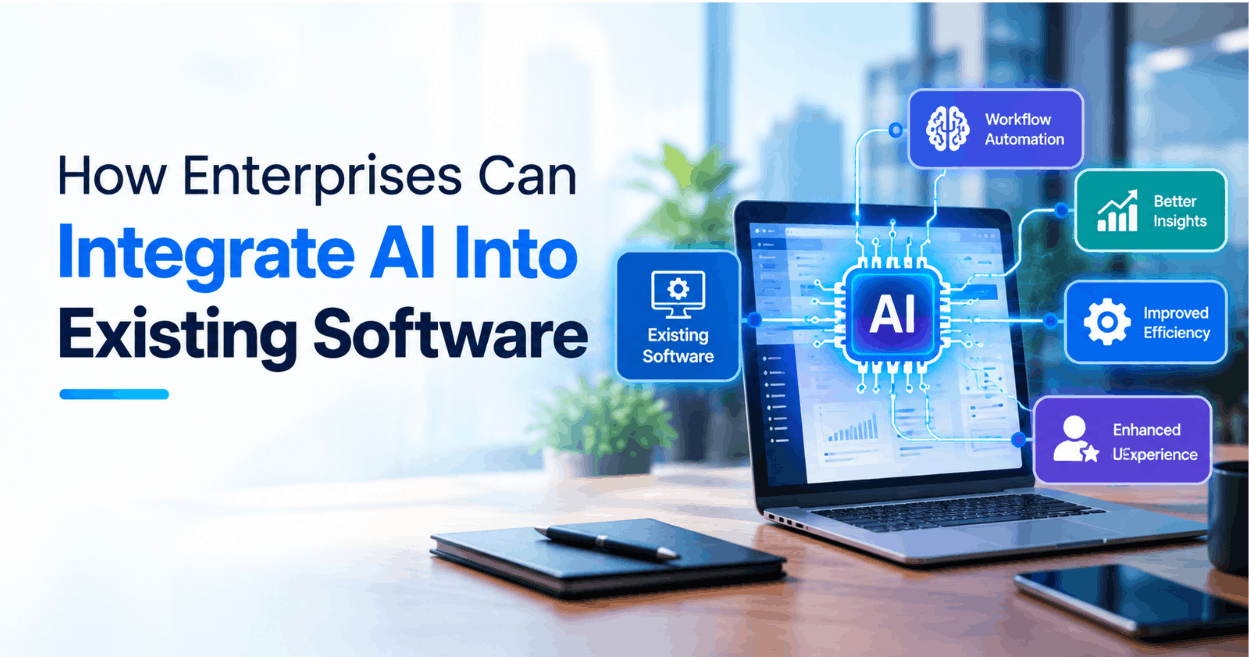

Artificial intelligence is becoming a practical part of enterprise software, but most organisations do not need to replace existing systems to benefit. Enterprises already depend on CRM platforms, ERP systems, databases, customer portals, finance applications and internal tools. Enterprise AI integration allows these systems to gain intelligent capabilities while keeping their core architecture and established workflows in place.
The objective is to connect AI with existing software. An AI software solution can support prediction, classification, document processing, intelligent search, recommendations or workflow automation. A structured integration strategy helps enterprises introduce these capabilities without creating unnecessary disruption, security risks or technical complexity.
Why Enterprise AI Integration Matters
Replacing a mature enterprise application can require significant investment, extensive data migration and lengthy employee training. Integrating AI into the existing environment can provide a more practical alternative. Businesses can improve selected processes while continuing to use existing software.
For example, AI can analyse CRM interactions and generate lead scores, identify sentiment or recommend follow up actions. In an ERP environment, AI can analyse operational data to support demand forecasting, anomaly detection or inventory planning. In document management systems, AI can extract information, classify files and assist with approval workflows.
The value of enterprise AI integration depends on choosing use cases that solve measurable business problems. The purpose should not be to add AI simply because the technology is available. The purpose should be to improve speed, accuracy, efficiency, decision making or customer experience.
Assess the Existing Software Environment
Before integrating AI, enterprises need an understanding of their technology environment. This includes application architecture, databases, APIs, authentication methods, cloud infrastructure, data pipelines and communication between systems.
An AI development company should examine how information moves through the organisation. This identifies integration points and technical limitations. Modern applications expose APIs that allow AI services to exchange data. Older applications may require middleware, custom connectors or additional integration layers.
Legacy software does not automatically prevent AI adoption. A carefully designed integration can add intelligent functionality while preserving the existing application. However, technical debt, outdated interfaces and limited computing resources need to be considered during architecture planning.
Identify the Right AI Use Cases
The next step is selecting the business processes where AI can provide measurable value. Common use cases include predictive analytics, document processing, recommendation systems, fraud detection, customer support automation, knowledge management and demand forecasting.
Generative AI can add another layer of functionality. Enterprises can use language models for summarising documents, creating internal assistants, answering employee questions, generating reports or interacting with enterprise knowledge bases.
The selected use case should have a defined objective, suitable data and measurable performance indicators. For example, reducing support response time provides a clearer target than simply deciding to implement an AI chatbot.
Choose the Right Integration Architecture
AI can be integrated into existing software through several architectural approaches. An API based model integration allows an application to send relevant information to an AI service and receive a prediction, classification or generated response. This approach is useful when the organisation wants to use a centrally managed model.
A microservice architecture can isolate AI functionality from the main application. The AI service can operate independently and communicate with other components through APIs or messaging systems. This reduces coupling and can simplify scaling, testing and model updates.
For enterprise knowledge applications, retrieval augmented generation can connect a language model with approved internal information. The system retrieves relevant content before generating a response, which can improve contextual accuracy and reduce dependence on information contained only within the model.
Model selection should follow the system requirements. The architecture should reflect security, scalability and business requirements.
Prepare and Govern Enterprise Data
AI performance depends on data quality. Existing enterprise systems may contain duplicate records, missing values, inconsistent formats or outdated information. Feeding poor quality data into an AI system can reduce reliability and make otherwise strong models less useful.
Data preparation may involve cleansing, transformation, validation and classification. Enterprises should also define access rules that determine which users and applications can retrieve specific information.
Security controls should include appropriate authentication, authorisation and encryption. Sensitive business information should not be exposed to an AI service simply because the application can access it. Data retention policies and audit requirements should also be considered.
For generative AI applications, organisations should identify authoritative information sources and establish rules for how enterprise data is retrieved. Retrieval augmented generation can help connect models with controlled knowledge repositories while maintaining a clearer relationship between responses and approved information.
Integrate AI With Existing APIs and Workflows
The AI component should become part of an existing workflow. APIs often provide the connection between AI capabilities and CRM, ERP, finance, human resources, ecommerce or custom applications.
Consider a CRM that receives customer enquiries. An AI service can analyse the enquiry, identify its category and urgency, generate a summary and return the result to the CRM. The existing workflow can then route the enquiry to the correct team without requiring employees to manually perform every classification step.
Event driven architecture can support similar processes. A new transaction, uploaded document or customer interaction can trigger an AI workflow automatically. This can reduce manual intervention and make AI available where it is needed.
Prioritise Security and Compliance
Security should be part of the architecture. Enterprises need to understand where AI processing occurs, which systems can access the model and how information moves between components.
Role based access controls can restrict AI generated information by user permissions. Encryption can protect data during transmission and storage. Audit logging can provide visibility into important AI assisted actions and support investigations when unexpected results occur.
Enterprises using external AI services should also evaluate data handling, retention and contractual requirements. Additional controls may be necessary for financial records, healthcare information, employee data or customer information.
Build Human Oversight Into AI Workflows
AI does not need to make every decision automatically. For many enterprise applications, human oversight provides a safer and more practical operating model.
An AI system can identify a potentially fraudulent transaction, recommend a customer response or flag an unusual business event. An authorised employee can then review the recommendation, inspect the supporting information and approve or reject the action.
This approach is important when AI outputs can affect finances, legal decisions, customers or operations. It also creates opportunities to collect feedback.
Test Before Production Deployment
An AI software solution requires testing beyond standard functionality. Enterprises should evaluate model accuracy, response quality, latency, scalability, security and failure behaviour.
Testing should use realistic business scenarios and representative data. Generative AI systems should be evaluated for inaccurate responses, irrelevant content, prompt injection and disclosure of confidential information.
A pilot can reduce deployment risk. Enterprises can compare AI assisted processes with existing workflows before expanding the system.
Monitor and Optimise After Deployment
AI integration does not end when the system reaches production. Business data, user behaviour, application workloads and model performance can change over time. Continuous monitoring helps identify changes before they affect outcomes.
Monitoring can include model accuracy, response latency, API availability, infrastructure usage and user feedback. Generative AI systems may also require monitoring of retrieval quality, response relevance and unexpected outputs.
Model versions should be managed carefully. Updates should be tested before production release, especially when AI functionality supports important business processes. An AI development company can help establish monitoring, optimisation and maintenance processes that support long term performance.
How Techasoft Supports Enterprise AI Integration
Techasoft provides AI implementation and AI integration services that help enterprises connect AI capabilities with existing applications, including CRM, ERP, databases, APIs, cloud platforms and legacy systems. Its services cover AI development, integration, testing, deployment and optimisation.
Techasoft also works with generative AI, large language models and retrieval augmented generation. Its capabilities include custom LLM and GPT development, RAG pipelines and integration with enterprise knowledge bases. This allows businesses to introduce AI into existing technology environments while maintaining their established software infrastructure.
With expertise across machine learning, natural language processing, predictive modelling and generative AI, Techasoft can support enterprises from initial AI planning through production deployment and ongoing optimisation.
Final Thoughts
Successful enterprise AI integration is primarily an architecture and business process challenge, not simply a model selection exercise. Enterprises need to understand their existing software, identify valuable use cases, prepare reliable data and establish secure connections between AI services and business applications.
A phased approach can make adoption more manageable. Start with a defined problem, integrate AI into the relevant workflow, measure the outcome and expand the implementation when the results justify further investment.
With appropriate governance, testing, monitoring and human oversight, enterprises can introduce AI while protecting existing technology investments. The result is an AI software solution that works within the enterprise organisation rather than operating separately from it.
FAQs
1. What is enterprise AI integration?
Enterprise AI integration is the process of connecting artificial intelligence capabilities with existing enterprise software, data and workflows. It can involve CRM systems, ERP platforms, databases, APIs, cloud services and legacy applications.
2. Can AI be integrated into legacy software?
Yes. AI can be connected to legacy applications through APIs, middleware, custom connectors or integration services. The approach depends on the architecture, data access and technical limitations of the existing system.
3. What does an AI integration company do?
An AI integration company assesses existing systems, designs the integration architecture, connects AI models with business applications, tests the implementation and supports monitoring and optimisation after deployment.
4. How does an AI software solution improve enterprise operations?
An AI software solution can automate repetitive tasks, analyse large datasets, generate recommendations, support decision making, classify information and improve access to enterprise knowledge. The specific benefit depends on the selected use case.
5. Why choose Techasoft for enterprise AI integration?
Techasoft provides AI integration services for enterprise systems including CRM, ERP, cloud platforms, databases, APIs and legacy applications. Its services cover planning, development, integration, deployment, testing and optimisation, helping enterprises introduce AI into existing technology environments.