








Every sales team knows the frustration: you have a great product, a polished pitch, and a CRM full of prospects, but inbound leads are trickling in at a pace that barely moves the needle. Your competitors keep showing up on page one of Google while you're stuck on page four.
Here's the hard truth: rankings drive pipeline. And in 2025–2026, the businesses winning the organic search game aren't always the ones with the biggest budgets; they're the ones who made a smart, strategic decision to outsource their SEO to specialists.
This guide breaks down exactly how outsourced SEO accelerates pipeline growth, what the process looks like from day one, and how to make sure you're choosing the right partner, not just a vendor.
What Is SEO Outsourcing, and Why Does It Matter for Growth?
SEO outsourcing means handing your search engine optimization strategy, execution, and reporting to an external agency, specialist team, or consultant rather than trying to manage it in-house.
It’s not about giving up control. It’s about multiplying your capacity.
When done right, outsourced SEO becomes one of the most efficient growth levers a business can pull. With SEO outsourcing in India, you gain access to a full team of professionals, technical SEOs, content strategists, link builders, and data analysts without the overhead of hiring, onboarding, or managing each one internally.
The Connection Between Rankings and Revenue
Rankings are not a vanity metric. A first-page Google ranking for a high-intent keyword can directly translate to:
- Qualified inbound leads who are actively searching for what you offer
- Shortened sales cycles because prospects arrive already informed
- Lower customer acquisition costs (CAC) compared to paid channels
- A compounding return, unlike ads that stop the moment you stop paying
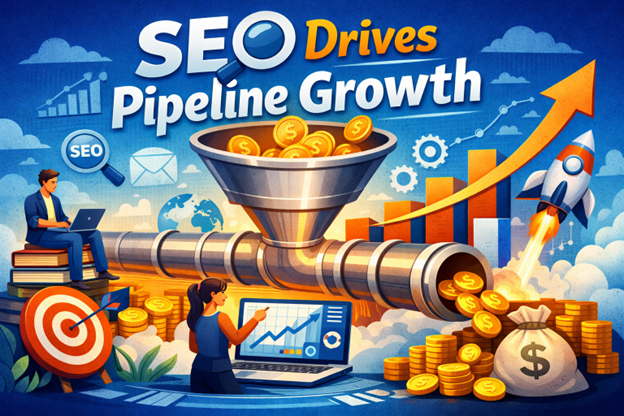
This is the SEO pipeline effect: organic visibility consistently feeds your funnel with warm, intent-driven prospects.
Why Most Businesses Struggle to Do SEO In-House
Before exploring the benefits of outsourcing, it's worth understanding why so many companies hit a wall when managing SEO internally.
The Expertise Gap Is Real
Effective SEO in 2025 is not a one-skill discipline. It demands expertise across technical auditing, content strategy, keyword research, Core Web Vitals, link acquisition, structured data, and increasingly, Generative Engine Optimization (GEO), making your brand visible inside AI-generated search answers like Google's AI Overviews.
Hiring one in-house SEO specialist means getting a generalist. Outsourcing means accessing an entire team of specialists.
The Tool Cost Problem
Professional SEO requires premium tools: Ahrefs or Semrush for keyword and backlink analysis, Screaming Frog for technical crawls, Surfer SEO or Clearscope for content optimization, and several others. The combined annual cost of these tools easily exceeds $10,000–$15,000, before you factor in salaries.
When you outsource, these costs are absorbed by the agency, often as part of the monthly retainer.
Algorithm Changes Never Stop
Google rolls out hundreds of algorithm updates every year. Major core updates can shift rankings overnight. Keeping up with those changes while running a business is simply not realistic for most teams. An outsourced SEO partner tracks every update, adjusts strategy proactively, and protects your rankings from sudden drops.
The 7 Biggest Benefits of Outsourced SEO for Pipeline Growth
1. Faster Time-to-Ranking
An experienced outsourced SEO team won't spend months figuring out your industry; they've done it before. They have repeatable frameworks, proven keyword strategies, and efficient content workflows that compress the time it takes to move from "new engagement" to "page one visibility."
For businesses trying to build a pipeline, speed matters. Every month spent at the bottom of Google is a month of lost leads.
2. Access to a Full-Stack SEO Team Without the Payroll
When you partner with a reputable SEO agency, you typically get:
* Technical SEO specialists who audit your site architecture, page speed, indexation, and crawlability
* Content strategists who build topical authority through cluster-based content planning
* Link-building experts who pursue high-authority placements to boost your domain's credibility
* Data analysts who track performance, interpret trends, and refine strategy
* Account managers who keep you informed and aligned on goals
Replicating this in-house would require hiring 4–6 people. Outsourcing delivers the same firepower at a fraction of the cost.
3. Scalability Without Disruption
Business needs change. Maybe you're launching a new product line, entering a new market, or ramping up for a seasonal push. In-house teams are constrained by headcount. An outsourced SEO partner can scale content production, link outreach, and technical work up or down based on your goals, without the delays of recruiting or the risks of layoffs.
4. Data-Driven Decision Making From Day One
Guesswork in SEO is expensive. Professional agencies operate with rigorous data pipelines: tracking keyword positions daily, monitoring competitor movements, analyzing user behavior, and tying SEO activity to pipeline metrics like leads generated and revenue influenced.
You won't just get rankings reports, you'll get business intelligence.
5. Topical Authority That Outlasts Your Competitors
Modern SEO isn't about stuffing a page with keywords. It's about becoming the definitive resource in your niche, what Google's systems recognize as an authoritative, trustworthy source on a given topic.
Outsourced SEO experts build content clusters: a pillar page on a broad topic, supported by multiple in-depth articles on related subtopics. This architecture signals topical authority, drives more rankings across the funnel, and creates a flywheel effect that compounds over time.
6. Better ROI Than In-House or Paid Alternatives
Here's a direct comparison most businesses never see side by side:
|
Factor |
In-House SEO Team |
Outsourced SEO Agency |
|
Monthly Cost |
$8,000–$20,000+ (salaries + benefits) |
$1,500–$8,000 (retainer) |
|
Tool Access |
Extra $1,000–$1,500/month |
Included |
|
Depth of Expertise |
1–2 generalists |
Full specialist team |
|
Scalability |
Slow (hiring cycles) |
Flexible and immediate |
|
Algorithm Adaptability |
Inconsistent |
Proactive and ongoing |
|
ROI Timeline |
12–18 months |
6–12 months (faster ramp) |
SEO consistently delivers some of the highest long-term ROI of any marketing channel. Outsourcing removes the friction that prevents businesses from capturing that return.
7. Frees Your Team to Focus on Closing
Every hour your marketing team spends trying to understand Core Web Vitals or troubleshoot a crawl error is an hour not spent on campaigns, messaging, or supporting sales. Outsourcing SEO gives your team back the focus to do what they do best, while the pipeline continues to fill in the background.
How Outsourced SEO Actually Drives Pipeline: A Step-by-Step Look
Understanding the benefits is one thing. Seeing exactly how the process works, from kickoff to lead generation, is what builds confidence in the decision.
Phase 1: Discovery and Audit
A thorough SEO engagement starts with understanding your current state. This includes:
* A complete technical audit of your website (site speed, mobile performance, crawl errors, indexation issues)
* A content audit to identify what's ranking, what isn't, and what has potential
* Competitive analysis to map out who you're fighting for rankings, and why they're winning
* Keyword research aligned to your buyer journey: awareness, consideration, and decision-stage terms
The output of this phase is a prioritized roadmap, not a list of generic tasks, but a specific plan built around your pipeline goals.
Phase 2: Technical Foundation (Weeks 2–6)
Before content or links can move the needle, the technical foundation must be solid. This means:
- Fixing crawl errors and resolving indexation blockers
- Improving site speed and Core Web Vitals scores
- Implementing proper schema markup for rich results
- Ensuring mobile-first optimization across all key pages
- Aligning URL architecture with your target keyword strategy
Think of this as clearing the runway. Without it, even great content won't rank.
Phase 3: Content Strategy and Creation (Ongoing)
With a clean technical foundation, the agency shifts to content, the engine of long-term pipeline growth.
Building Content That Converts, Not Just Ranks
The best outsourced SEO teams don't just write for algorithms. They write for buyers. Every piece of content is mapped to a specific stage in your sales funnel:
* Top-of-funnel (TOFU): Educational blog posts targeting informational queries, building brand awareness among prospects who don't know you yet
* Middle-of-funnel (MOFU): Comparison guides, case studies, and "how to choose" content targeting consideration-stage keywords
* Bottom-of-funnel (BOFU): Service pages, landing pages, and solution-focused content targeting high-intent queries that signal purchase readiness
This funnel-aligned content strategy is what turns rankings into leads and leads into revenue.
The Role of AI Overviews and GEO
Google's AI-generated search summaries now appear before organic results for millions of queries. If your content isn't structured to be cited in those overviews, you're losing visibility you can't buy your way back into.
Experienced outsourced SEO teams now build content with GEO principles in mind: clear answers to specific questions, authoritative sourcing, structured data, and content that demonstrates first-hand expertise. This ensures your brand earns placement in AI-generated results, not just traditional blue links.
Phase 4: Link Building and Authority Development (Ongoing)
Backlinks remain one of the most powerful ranking signals Google uses. But the quality bar is higher than ever. Spammy directories and private blog networks do more harm than good.
Professional outsourced SEO involves:
* Digital PR: Creating newsworthy content that earns links from high-authority media and industry publications
* Guest posting: Publishing thought leadership on relevant, respected platforms
* Link insertion: Earning contextual backlinks in existing high-traffic content
* Competitor link gap analysis: Identifying where competitors have authority and pursuing the same sources
Each authoritative link is a vote of confidence that elevates your domain's credibility and your rankings.
Phase 5: Reporting and Pipeline Attribution (Monthly)
Pipeline growth requires measurement. Your outsourced SEO partner should provide monthly reporting that goes beyond keyword rankings. The metrics that matter for business growth include:
- Organic sessions and session growth rate
- Leads generated from organic traffic (form fills, calls, demo requests)
- Keyword position improvements across target terms
- Share of voice compared to competitors
- Revenue influenced by the organic channel
The goal is to connect SEO activity directly to business outcomes, not just show you a green arrow next to a keyword.
What to Look for When Choosing an Outsourced SEO Partner
Not all SEO agencies are created equal. Here's how to separate the ones who will drive real pipeline growth from those who will deliver monthly reports full of metrics that don't move your business.
Ask the Right Questions Before You Sign
Before engaging any SEO partner, get clear answers to the following:
1. Can you show us results from clients in our industry or a comparable one? Case studies should include before/after ranking data, traffic growth, and, ideally, lead or revenue impact. Generic testimonials don't cut it.
2. How do you approach content strategy? Look for evidence of funnel-aligned thinking, topical authority frameworks, and an understanding of buyer intent, not just keyword volume targets.
3. What does your link-building process look like? Legitimate agencies are transparent about their outreach methods. If they're vague or promise hundreds of links per month, that's a red flag.
4. How do you adapt to algorithm updates? Any competent agency should be able to walk you through how they responded to a recent major update, what changed, what they did, and what the outcome was.
5. What does your reporting cover, and how does it connect to our business goals? If the answer is "monthly keyword rankings," keep looking. You want an agency that can show the connection between SEO performance and pipeline metrics.
Red Flags to Avoid
Watch out for agencies that:
- Promise guaranteed first-page rankings in a set number of days
- Use vague language about their "proprietary process" without being able to explain it
- Focus almost entirely on the quantity of content or links without discussing quality
- Can't provide references or detailed case studies
- Don't ask about your sales process, target personas, or pipeline goals
Legitimate SEO partners ask good questions because they understand that rankings are a means to an end, and that end is business growth.
Outsourcing Models: Which One Fits Your Business?
There's no one-size-fits-all approach to outsourcing SEO. Depending on your budget, team structure, and goals, different models may suit you better.
Full-Service SEO Agency
Best for businesses that want a comprehensive partner handling strategy, content, technical SEO, and link building under one roof. This is the most effective model for driving meaningful pipeline results, particularly for companies with competitive markets or ambitious growth targets.
Specialist Freelancers
Best for businesses with a clear, narrow need, for example, a technical SEO audit, a specific content project, or link building for a particular page. Freelancers can be cost-effective for targeted work but lack the breadth to execute a full-funnel strategy.
White-Label SEO
Best for marketing agencies that want to offer SEO services to their clients without building an internal SEO team. A white-label provider operates behind the scenes under your brand.
Hybrid Model
Best for businesses with some internal SEO capacity, perhaps a content marketer or a developer familiar with technical SEO, who need external specialists to fill specific gaps. The outsourced team handles the areas requiring deep expertise while the internal team manages day-to-day content publishing.
Common Myths About Outsourcing SEO
We'll lose control of our brand voice.
Not true if you choose the right partner. Quality SEO agencies begin every engagement with brand voice documentation, editorial guidelines, and approval workflows. You review content before it's published.
It takes too long to see results.
SEO does require patience, typically 3–6 months before meaningful ranking improvements appear. But the businesses that say SEO "doesn't work" are usually those that stopped before the compounding returns began. The right framing: it's a long-term asset, not a short-term campaign.
We can just use AI to write all our content.
AI-generated content at scale is increasingly detectable and is being filtered by search engines. What ranks in 2025–2026 is content that demonstrates genuine expertise, original insights, and human editorial judgment. Agencies that blend AI efficiency with human quality control outperform those relying on either alone.
Our industry is too niche for SEO to work.
The narrower your niche, the less competition you have for high-intent keywords. Niche businesses often see faster ranking gains and higher conversion rates because the people searching are extremely qualified.
Making the Transition: How to Get Started With Outsourced SEO
If you're ready to move from leads at a trickle to a pipeline at scale, here's how to start the process on the right foot.
Step 1: Define What Pipeline Growth Looks Like for You
Before you brief a single agency, get clear on your goals. Is it 50 qualified inbound leads per month? A 30% increase in organic traffic? First-page rankings for 10 specific high-intent keywords? Concrete goals lead to better agency selection and more meaningful measurement.
Step 2: Audit Your Current SEO Baseline
You need to know where you're starting from. Use free tools like Google Search Console and Google Analytics to understand your current organic traffic, top-performing pages, and existing keyword rankings. This baseline will be essential for measuring the ROI of your outsourced investment.
Step 3: Request Proposals From 3–5 Agencies
Give each agency the same brief: your business, your goals, your current baseline, and your budget range. Evaluate their responses not just on price, but on how deeply they understood your business problem and how specifically they proposed to address it.
Step 4: Start With a Defined Engagement, Not an Open-Ended Contract
The best agencies don't need to lock you into a 12-month contract before proving their value. Start with a defined scope, an audit and strategy phase, for example, and evaluate the quality of their thinking before committing to long-term execution.
Step 5: Build a Communication Cadence
Agree upfront on how often you'll meet, what's included in monthly reports, and how you'll handle content approvals. Clear communication protocols prevent misalignment and keep the engagement moving fast.
The Bottom Line: Rankings Are Pipeline
The businesses that consistently outgrow their competitors aren't necessarily outspending them. They're out-ranking them, and they're doing it by making smart decisions about where to invest their resources.
Outsourced SEO is not an expense line. When executed strategically, it's a pipeline-building machine: one that attracts qualified buyers, nurtures them through relevant content, and delivers leads to your sales team who are already convinced you're the right solution.
The compounding nature of organic search means the investment you make today continues to generate returns for months and years. Every article that ranks, every backlink that earns authority, every technical improvement that speeds up your site, these are assets that build on each other.
If your pipeline depends on paid ads that stop the moment you pause the budget, it's time to add organic as a sustainable, scalable growth channel.
The path from leads to rankings starts with a single decision: to stop treating SEO as a task and start treating it as a strategy.
Frequently Asked Questions
How much does outsourced SEO typically cost?
Pricing varies widely based on scope, market competitiveness, and agency experience. For small to mid-sized businesses, monthly retainers typically range from $1,500 to $8,000. Enterprise-level engagements can go significantly higher. The key is to evaluate cost against expected return, not just against competitors' pricing.
How long does it take to see results from outsourced SEO?
Most businesses see measurable movement in keyword rankings within 3–4 months, with meaningful traffic and lead impact typically appearing within 6–12 months. Timelines vary based on your starting domain authority, market competitiveness, and the aggressiveness of the strategy.
What's the difference between outsourced SEO and hiring an in-house SEO manager?
An in-house SEO manager brings one person's expertise. Outsourcing brings a team. For most small to mid-sized businesses, the depth and breadth of an outsourced team significantly outperforms what a single hire can accomplish, at a comparable or lower total cost.
Should we outsource all of our SEO or just parts of it?
That depends on your internal capabilities. If you have a strong content team but lack technical expertise or link-building capacity, a specialist engagement may be sufficient. If you have no SEO infrastructure at all, a full-service agency is typically the fastest path to results.
How do we measure whether outsourced SEO is actually driving the pipeline?
Set up proper attribution in Google Analytics, linking organic sessions to conversions. Ask your agency to report on leads and revenue influenced by organic traffic, not just keyword rankings. Review the organic-attributed pipeline in your CRM quarterly.



Post Comments