






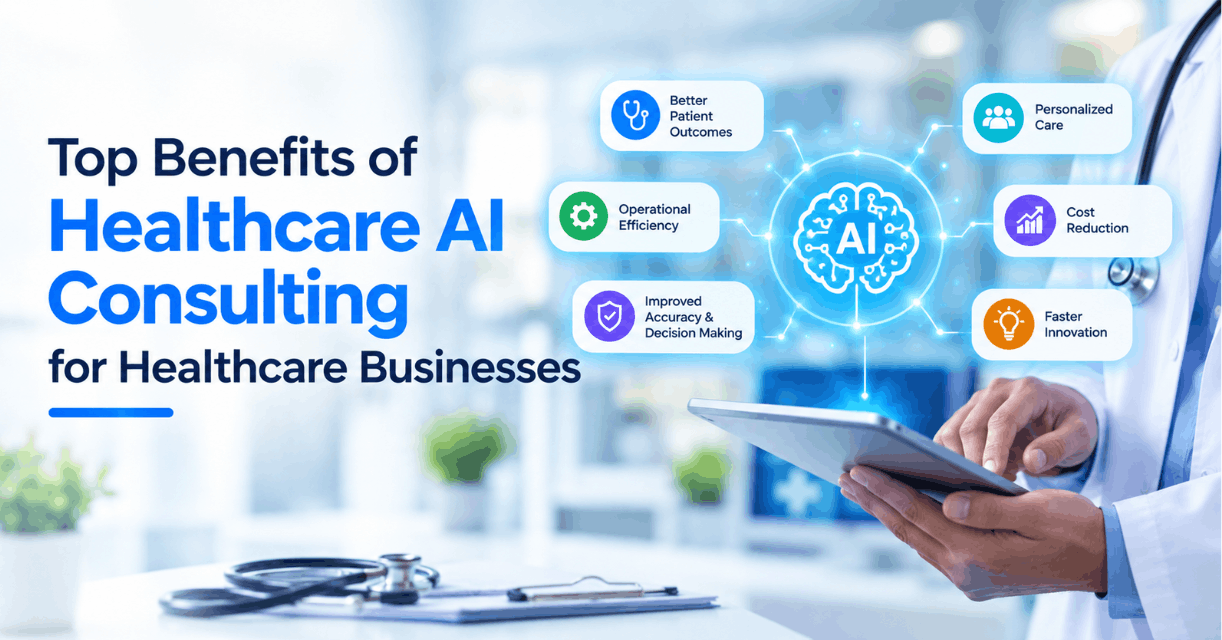

Healthcare is changing realy fast, and artificial intelligence is becoming one of those key technologies pulling the transformation forward. In practice, from clinical decision support and predictive analytics to virtual assistants, plus intelligent patient management, AI is helping healthcare orgs improve how they deliver services, and also how they run day to day operations.
Still, adopting AI the right way isn’t just about buying an AI powered tool. Healthcare businesses should first spot the best use cases, get their data in shape , and connect AI with the systems already in place, while also covering privacy concerns and regulatory requirements. This is sort of exactly where healthcare AI consulting can bring real momentum.
When you work with experienced AI consultants, healthcare organizations can build a useful AI strategy that fits their business objectives, without piling up too many implementation risks. Lets go through the main benefits next.
Top 10 Benefits of Healthcare AI Consulting
1. Develop a Clear AI Strategy
Lots of healthcare organizations can see where AI might help, but still they end up unsure of “where to begin” and honestly it can be messy. If you roll out AI with no clear direction or plan, you can wind up wasting money, ending with disconnected systems, and getting tools that dont really show measurable impact in the end.
In practice, healthcare AI consultants take a close look at current workflows, existing technologies, the data foundation in place, and the organizations business goals. From there they spot AI use cases that actually fit, then they help sort the options in a priority order based on things like expected ROI, how hard the rollout would be, the patient impact, and whether the approach can expand over time.
So instead of doing a lot of trial and error, you get a more organized roadmap, with steps that make sense.
2. Improve Patient Care and Experiences
One of the biggest pluses of AI in healthcare is that it can help enable more personalized and kind of responsive patient care, sorta. AI platforms can chew through patient data, spot patterns , give a hand with risk prediction, and assist healthcare professionals in making quicker, data-driven choices. Also, AI-powered virtual assistants can manage the everyday stuff, like answering routine questions, appointment scheduling , reminders, and light patient interactions.
From a patients perspective , this usually translates into less waiting time, simpler access to information, and a more customized experience, not just generic care.
So for healthcare businesses, it’s worth partnering with a seasoned AI Consulting company, to find where smart technologies can complement healthcare professionals, instead of trying to swap them out completely.
3. Increase Operational Efficiency
Healthcare orgs deal with a bunch of routine, day to day processes, like appointment scheduling, billing, documentation, claims handling, data entry, plus administrative messages.
AI is able to automate a good portion of these things, so staff can spend more time on activities that really need human judgment or direct interaction.
As a simple example, intelligent document processing can pull out relevant info from medical records, and AI scheduling tools can help with better appointment planning and resource allocation. In general, automation cuts down the manual grind, while keeping results more consistent and speeding up processing.
For groups managing heavy patient volumes, these kinds of upgrades can end up making a real difference in total day to day operational efficiency.
4. Unlock the Value of Healthcare Data
Healthcare organizations put out a huge amount of information through electronic health records, medical devices, laboratory systems , imaging platforms , insurance systems, and patient applications. So the issue isn’t only about gathering all that stuff. It’s about turning those scattered pieces of data into something useful, like actionable insights and not just noise.
AI consulting can support organizations in setting up a data strategy that backs analytics , machine learning, and even predictive applications. In this work, consultants often review data quality, spot integration hurdles, and suggest fitting technologies for organizing as well as analyzing healthcare information. They basically help connect the dots, even when the sources are kind of stubborn.
When data is used in a stronger way, organizations can surface patterns, keep an eye on day-to-day operational performance, and end up making more informed business choices alongside clinical decisions, at least that’s the goal.
5. Support Predictive Analytics
AI can help healthcare orgs sort of pivot away from reactive decision- making toward more predictive ways, even when things feel a bit chaotic. Machine learning models can sift through historical data along with live feeds, then surface those patterns linked to patient risks, needed resources, operational slowdowns, or basically other business results.
Like, predictive models might let a team foresee patient demand earlier, flag people who may need extra follow-up, or tune staffing schedules and resource distribution so it doesn’t feel like guesswork all day. And in practice, AI consultants can support the process of deciding which predictive use cases are actually feasible for a given organization, depending on what data they already have, their current tech setup, and the real operational needs.
6. Strengthen Healthcare Application Development
AI is getting to be a main, almost foundational, part of many today's healthcare apps. In practice, patient portals, telemedicine platforms, remote monitoring solutions, wellness applications, and hospital management systems can all incorporate “smart” features in ways that support care.
For teams that are planning to build new or modernize existing apps, it helps to work with a dedicated Healthcare app development company. The key is that they should understand not only software engineering, but also the healthcare-specific rules and constraints that come with it.
AI consulting is also useful early in the development cycle. That’s where you figure out what should be inside the product. Maybe it’s AI chatbots, recommendation engines, predictive analytics, voice interfaces, automated documentation, or intelligent search, depending on the context.
Once these AI-powered healthcare applications are ready for deployment, testing across different devices and browsers becomes important to ensure they work as expected. Automated testing can help teams validate key workflows consistently, especially when applications need to support multiple platforms and frequent updates. Tools such as TestGrid can support this process by enabling teams to test healthcare applications across real devices and browsers, helping identify compatibility issues before they affect users.
Doing it this way guides the business toward building applications around real user and operational needs, rather than just adding AI because it’s trending, or because everyone else is doing it.
7. Enhance Cybersecurity and Risk Management
Healthcare data is, like, extremely sensitive so security becomes a huge deal for any AI initiative, even if it sounds boring. AI also can back cybersecurity up by spotting weird or unfamiliar activity, finding possible threats, keeping an eye on system behavior, and helping security teams respond to risks in a faster, more coordinated way.
But at the same time, AI systems bring their own set of worries, like how data access is handled, how the model is protected, privacy concerns, and governance requirements. And yeah, all of that needs attention before anything goes live.
Healthcare AI consultants can help organizations set up the right security and governance structure first, before deploying any AI solutions. That might mean laying out access controls, agreeing on data-handling practices, setting up monitoring processes, and putting in place risk management procedures, in a way that’s practical for the day-to-day.
8. Ensure Regulatory and Ethical Readiness
Healthcare AI has to work inside a tricky environment where privacy , security , regulation , and ethics all come together, at the same time, kind of. Organizations really need to think through patient data how it is gathered, processed, and even how the AI ends up producing decisions. Also, they should watch how the models behave over time, and then ask if the people using the system can actually understand what is going on, or push back against an automated outcome, if something feels off.
In many cases, consulting teams can be useful for healthcare businesses, because they can weave governance and compliance needs into an AI plan from day one , instead of treating it like a late repair job. Honestly, it tends to be way more effective to plan for regulatory concerns early, rather than trying to fix them after the AI has already been put into production.
When responsible AI practices are followed, trust can grow too, not only with patients but also with healthcare professionals and the wider set of stakeholders involved.
9. Reduce AI Implementation Costs and Risks
AI projects can turn out really expensive when organizations pick off-the-shelf tech that’s not a great fit , underestimate the integration stuff, or try to craft big complicated systems without enough know how. It’s kinda common too, they think it’ll be straightforward but the coupling and dependencies hit later.
In that case, consultants can step in to sort of assess the different technology options and lay out implementation plans that actually reflect reality, not just wishful diagrams. They can also suggest a path for each capability: maybe it should be built internally, or plugged into an existing platform, or handled as a custom solution , depending on constraints.
Using a phased rollout helps even more with risk . Start with one specific use case, track performance, absorb lessons from the deployment , and then widen the AI adoption gradually instead of flipping everything on at once.
That approach tends to make the whole AI transformation more doable and also more financially predictable .
10. Build a Scalable Foundation for Future Growth
AI adoption really isn’t a one-time project, more like it keeps going. As the technologies keep evolving, and healthcare orgs produce even more data, their AI needs, likely will grow too. So a well planned AI strategy should kinda assume future scalability from the start, not just focus on what works today.
In practice, healthcare businesses end up needing architectures that can handle new models, more data feeds, changing workflows and also smooth integration with whatever new technologies show up. Otherwise everything feels brittle, or it turns into a mess later.
That’s where consultants can be useful they can help organizations build a flexible AI ecosystem rather than a couple isolated applications. When you do it this way, it’s generally easier to roll out new capabilities as the business requirements shift, and you don’t have to restart everything every time.
Conclusion
Healthcare AI software consulting can help companies shift from testing artificial intelligence in small trials to rolling it out strategically, you know not just for show. It can improve patient experiences, streamline paperwork and admin workflows, and also help unlock healthcare data in a way that actually matters, plus enable predictive analytics and smarter decision support. In short, AI can bring clear value across several parts of day to day healthcare operations.
Still, the hard part is that success usually isn’t only about having the newest technology on hand. Organizations also need the proper game plan, a solid data foundation, a security framework that holds up, a compliance approach that fits the rules, and enough development know how to build and maintain what they start.
When healthcare teams partner with seasoned AI consultants, and specialized technology partners too, they can spot practical AI opportunities faster, cut down on implementation risks, and design scalable solutions that are ready for whatever comes next in digital healthcare.